Categories
ideas & suggestions

Narrative Immersion

I focused on how technology can enhance and change our engagement with narratives in a previous post, so I’m going to step back and look at the highly immersive nature of text-based books as a medium.

After recently finishing a book and scanning my shelves for my next literary foray, my eyes settled on a fairly large book, and although initially daunted by its length, knowing that it would take me a fair while to finish even if engrossed, I soon started to relish the idea. I realised I would have a portable, episodic experience that I could dip into for the next few weeks, becoming instantly immersed as I did so – the narrative spurring ever more interest and giving heightened importance to the outcome (due to discovering more about the characters and investing in their stories), and possibly even gaining relevance to external events as I progressed.

Being able to burn through an entire book in one go makes the experience rather like watching a film; reading it in parts is more akin to a TV series, or a video game with a story that is revealed as the player moves ahead. It could be suggested the latter two allow a greater level of expectation and intrigue to build between narrative points (due to the real-world time elapsed), but all three mediums still dictate visual messages to the audience, albeit being open to multiple interpretations. Books allow the reader to paint their own visuals in their mind, forming structures within, giving characters familiar faces from their own lives, and grasping unique meanings from what is said and done, filtered through their own past and ideologies. In short, they are dictated by readers as well as authors, leading to individual, self-contained experiences which change as they are reread later on in life.

It will be interesting to see how as technology constantly moves forward and the standard of presenting stories evolves beyond text and the spoken word how this experience might be preserved. Might it even be mimicked, through bespoke forms of virtual reality systems, or audio books where the choice of narrator is tailored to the listener?

Categories
inspiration

Sewn Paper Sculptures

If you’ve been following this blog even remotely, you might have sussed my interest in papercraft and recycled materials, possibly partly due to my own artistic limitations. I’m in awe of artists who can do what I can’t – produce highly visual and sculptural pieces, rather than simply text, and particularly transform paper, something I use purely as a medium to scribble on and create artifices, into more then just a 2D vessel.

Continuing in this tradition, I’d like to share the work of Jennifer Collier, spied via the good folks at Fast Co Design. Using a sewing machine, she stitches found pieces of paper as if they were cloth, into all manner of three-dimensional sculptures. Shoes, clothes, everyday objects, even a camera and a typewriter – I think there’s a delicious absurdity in crafting a model of a tool, using the material it usually spews out.

Categories
ideas & suggestions

Shuffling Narrative

After my previous post speculating on the ways touchscreen devices will change the way readers engage with books and other texts in the future, I recalled an interesting example in the present.

The iPhone and iPad ‘A Visit from the Goon Squad‘ e-book app provides an option to re-order the hectic, backwards and forth narrative into chronological order, or even shuffle the chapters at random. However, these options are only available once the book has been read in its original order, meaning Jennifer Egan’s intended meaning won’t be lost.

This reminds me of cheat functions in video games, often unlocked once players complete the main body of the game (commonly known as “story mode”), granting them new ways to play and the ability to revisit past levels. This parallel seems like it could develop in the future – we might see e-books that reward readers for their time, or even their ways of interpreting the text, perhaps via intelligently recognised digital annotations, conceivably being used in an education context.

I suspect that being able to automate our interpretations and responses to literature and other art forms isn’t an entirely good idea, however. I think technology should facilitate and enhance engagement with them, but not instrumentalise the human element – our spontaneous, inspired, and unique reactions to works of art.

Categories
ideas & suggestions

“A Magazine Is An iPad That Does Not Work”

Yesterday I watched a video on YouTube of a child attempting to manipulate a magazine as if it were an iPad.

Eh? Bear with me.

As expected, the futile motions and the child’s baffled reactions are pretty funny, but it also made me ponder once again how touchscreen devices and future developments in technology will influence children’s perception of and attitude towards books, but more importantly, the act of reading itself.

Whilst digital content is currently co-existing alongside traditional printed media, it’s quite conceivable that in a decades time when it has the potential to overshadow it’s paper kin (rather than outright replace it), a child might live throughout their early years – before they have the opportunity to venture into the world alone and discover alternatives – rarely, if ever, reading “old” books and magazines.

If children only know books and applications that can employ videos, music, games and reader interactivity in a wide variety of ways, will paper and ink still be fulfilling? Will classic literature need to be remade in new digital dimensions to be valid for the next generation? There will certainly be very interesting and immersive techniques that will enable readers to connect with stories in unique ways, but I fear that older works might be neglected.

However, there’s also the possibility they will turn to printed books, and the contemplative, often passive manner of reading they foster, as an antidote to a constantly active, sometimes overloaded medium. It seems context plays a large part here – how would a reader focus on and engage with a multitude of different medias whilst braving a packed rush hour train journey, with all the physical restraints and stressful stimuli that entails?

I apologise in advance for any work put off due to random video YouTube tangents as a result of this post.

Categories
news updates & improvements

New eBook Design!

After some tinkering and testing, we’ve just uploaded the new eBook back cover designs to the bookleteer server. Alongside an improved colophon layout, all eBooks generated with bookleteer now automatically create a QR code link as well as a short URL, to the online bookreader version, featured on the bottom left corner of the back page. This means you can scan the code from a friends printed eBook with a smartphone or tablet device, to instantly bring up the digital version on your screen – another interesting dimension to hybrid publications. We’re looking forward to discovering similar intriguing uses…

Categories
inspiration

Psychedelic Paper Sculptures

Jen Stark creates fantastical, multicoloured paper sculptures which transgress the humble medium, composing simple sheets into three-dimensional works of art using every spectrum of the rainbow. The intricate layers, the shapes they form, and the sheer vibrancy of her work are mesmerising – what’s more, they’re all hand-cut. Perhaps it’s not wise to delve too deep into her catalog, if you have any pressing work to do…

Categories
ideas & suggestions

Business Cubes?

Whilst perusing the stalls at the TENT London design show a few weeks back, I was reminded of the importance of exhibitors’ business cards and informational flyers, especially when there’s a vast amount of finely crafted aesthetics and innovation competing for the attention of visitors, and potential investors or collaborators.

The ability for visitors at these kinds of shows to take a small souvenir away with them that serves as a contacts resource and reminder of the experience is key, particularly if the exhibitor is engaged in conversation or demonstrating their work to someone else, leaving no opportunity to directly talk to them and forge a link. I gathered quite a few cards at TENT – mostly as a trigger for later research – storing them in the back of my notebook so they wouldn’t get lost.

Often, there is a disparity between the design and information on these cards, and the intrigue I had when looking at the product or concept on display. It struck me that creating StoryCubes that act as keepsakes from the experiences might bridge this gap; shouldn’t high-end design work have a suitable counterpart for promotion? Obviously a cube is a lot more unwieldy than a card, even when folded flat, but perhaps in the process of taking the care to protect it, having to physically carry it rather than stuffing it into a wallet or pocket, it becomes more than just a scrap of details – a three-dimensional memento, almost a trophy, that can sit on a desk or shelf, hopefully stirring up the same interest its new owner had when looking at its source.

Categories
events

London Art Book Fair Picks

I paid a visit to the London Art Book Fair last Saturday at the Whitechapel Gallery, and have finally got around to writing a brief piece about it now – we’ve been swamped in the studio.

Along with large publishing houses, the fair played host to a number of small publishers and unique handcrafted artists’ books. A few of my picks…

Ruth Martin‘s charming fold-out creations.

Vicoria Browne’s (founder of Kaleid Editions) amazing sculptural pop-up book, ‘Dark Matter’.

This interesting cork cover from a/b Books (artist unknown).

Apologies for the meagre amount of photos – after taking a handful, I discovered photography was apparently FORBIDDEN. Bah.

Categories
events

Publish and be Damned Soapbox

Last week, I featured the Portable Reading Room at the London Art Book Fair 2011. Also making an appearance with a pop-up stall is Publish and be Damned, who run annual self-publishing fairs in London. The Publish and be Damned Soapbox will have new publications by their members, as well as host the launch of the first PABD magazine for alternative publishing and distribution, ‘Three Letter Words’.

11am – 6pm, on Saturday 24th September, in the Whitechapel Gallery foyer.

Categories
help & guides making sharing updates & improvements

Easy peasy way of making A4 & A3 StoryCubes on any printer

Recently, we’ve discovered a very, very simple way of making your own cardboard, hard-wearing StoryCubes, using only:

  • A free bookleteer account

If you haven’t signed up for a free bookleteer account yet, do so here.

  • A4 single label paper, suitable for Inkjet or Laserjet printers

Full sheet label paper, available from any decent stationers (Avery code: DSP01).

  • Blank StoryCubes

Read about StoryCubes, and order blank packs here.


Firstly, design your StoryCube.

Sign into bookleteer. If you’re a new user, read the help page.

Design your cube using the bookleteer templates, export the file as a PDF, then upload to the Create A StoryCube page, or upload each image individually.

Select Generate StoryCube and download the file, from the top right corner of the screen.

Next, print and make.

Print using the label paper, and cut around around only the faces of the cube, not the tabs – it should look a crucifix (You can also protect your cube by using adhesive cellophane, by affixing a layer on top of the label sheet, then cutting out).

Peel off the backing paper, and stick onto a blank cube.

Fold your StoryCube, and voila!

You can even use this method to make your own A3 size StoryCubes, without even owning an A3 printer.

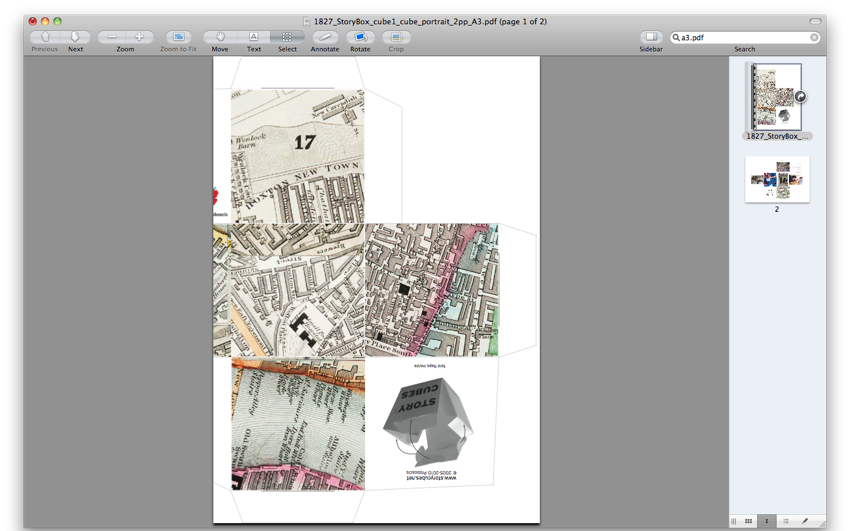
Simply crop the A3 cube PDF into two documents, so that it can be printed across two sheets of  A4 paper.


Then, cut out the two segments as shown, to form a two-part crucifix shape.

Stick onto to a blank A3 cube and fold…

… and you now have an A3 cube, using a standard home printer.

If any bookleteers discover more clever ways to make StoryCubes, do share!