bookleteer eBooks have often been used as sketchbooks or notebooks for people to draw or write in (as seen in yesterday’s post on ‘A Little Something About Me‘!) and one of the things I love best about them is that they are such a manageable size and look so handmade that it’s almost impossible to feel intimidated by the ‘blank white page’ and feel that your ideas are not going to live up to the notebook.
And now I find that Access Art understand precisely how a sketchbook can be a constraint as well as an inspiration! In Sketchbook Space, amongst all of their fabulous examples of sketchbooks, ideas for sketchbook activities and answers to the question ‘When to use a sketchbook’, they also provide the Scrappy Sketchbook. This is a 13 page PDF to download with a title page and 12 ‘blank’ pages each with an image of a different type of paper or surface. Download the PDF, make up the book using hole punch and string and you have a ready-made scrappy sketchbook that is totally blank and completely filled in – at the same time! You’ll never need to feel intimidated by the blank page again..
Some of the pages from the Scrappy Sketchbook
Of course, if it seems too much trouble to get out the hole punch you could always upload the PDF to bookleteer and generate it as an eBook, then all you need are scissors to complete your scrappy sketchbook.
Read more about the Scrappy Sketchbook and download the PDF here..
Schoolchildren in Umulogho; Schoolchildren in Watford
Writing yesterday about the importance of the tangible paper form of bookleteer reminded me of the ‘A Little Something About Me‘ project by Bev Carter carried out in 2007 – 2009 as part of Proboscis’ Generator Case Studies Residency Programme.
Bev wanted to make connections between her local school in England and the schoolchildren in Umulogho village, Imo state, Nigeria and the eBooks provided her with a way to do this.
The first eBook of the project, ‘A Little Something About Me‘, contained paintings, pictures and information by the students of the local school in Umulogho. The children were asked to write ‘a little something about me’ describing what learning meant to them, their hopes, fears, likes, dislikes etc. These eBooks were brought back to the UK and taken into Bev’s local school where the British children read and responded to the Umulogho eBooks helping to devise the questions for a second eBook called ‘Kedu? How Are You?‘ which was made online then printed out and sent out to Umologho early in 2008.
From Kedu? How Are You? eBook: Questions about Umulogho by British schoolchildren illustrated with pictures by students in Umulogho from the A Little Something About Me eBooks
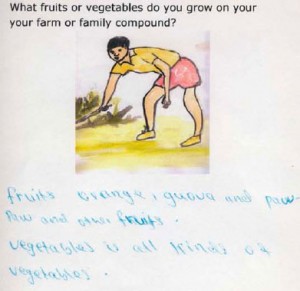
The ‘Kedu? How Are You?‘ eBook (Kedu means ‘How are you? in Igbo, the main language spoken in Umulogho Village) was designed as a notebook to be completed by the children in Umulogho, responding to questions asked about them and their lives by British schoolchildren. Filling in the eBook also enabled the children of Umulogho to ask questions of the children in Watford such as ‘what seasons do you have in England?’ and ‘what religions do you have?’
Response to the Kedu? How Are You? eBook by students in Umulogho
In October 2008 the completed Kedu eBooks were taken back to the school in Watford that had asked the original questions. The students were delighted to see the answers to their questions, such as ‘are there any crocodiles in the village stream?’ (some Umulogho students had seen some and others hadn’t) and got the students talking about the differences between the everyday lives of the Umulogho children and their own – for example, what time they wake up in the morning and what they do before school as most students in Umulogho were awake by 5.30 am and had gone to the village stream and back to collect water before going to school.
Response to the Kedu? How Are You? eBook by students in Umulogho
Even though the school in Umulogho doesn’t yet have a computer or internet access, it was still possible to send and receive paper copies of the eBooks, and by scanning in the completed eBooks the results could be shared online. In this way a conversation was able to be held across continents, cultures and technological formats.
Read more about the project and download the Umulogho eBooks at diffusion.org.uk
Alan Chamberlain, one of our PU&P Augmented Reading participants, posted a link to the bookleteer Facebook page about a programmable surface that has been created by researchers at MIT and Harvard. The composite material which looks pretty much like a piece of paper can fold itself into a number of predetermined shapes (in this case a boat, a plane and a tent) when an electric current is passed through it. The ‘paper’ contains a number of foil actuators to make it fold and tiny electromagnets to ensure it stays folded.
Researchers believe that one application might be to create containers that can change their size to adjust to the amount of liquid being poured into to them. Another might be to make StoryCubes that can expand and shrink depending on how much is written on them or how many people are collaborating. But they probably haven’t thought of that specific use yet..
Read more about it on wired.com where you can also see a video of it in folding action.. (Thanks Alan!)
While I was thinking about augmented reading in preparation for yesterdays PU&P (which was fab – thanks guys!) Giles showed me the Trail Song project by Julie Myers who he commissioned as part of the Transformations series.
The Whyte Museum Archive, Banff, describes a Trail Song in this way:
“A Trail Song uses a well known song or tune but replaces the lyrics with words of its own. These words reference objects, people and places experienced on the journey” (Trail Songs Magazine (1954) – The Whyte Museum Archive, Banff, CAN).
In 2009 Julie created her own Trail Song around a journey from San Francisco, US to Banff, Canada – 1,345 miles by car, coach and ferry. The Trail Song lyrics were captured in an eBook while a set of four StoryCubes show photographs of the people and places she encountered on different stages of the journey. Julie writes:
“In the tradition of the Trail Songs of North America, we invent lyrics as we travel from place to place. Like modern day Songlines these songs tell about the geography and the people of the landscape, each song refers to a direction or path taken and is matched to the video footage we shoot en route. The original tune is something we might overhear on a street corner, in a café or on the car radio.”
I think my favourite part though is the video where you see snippets of her family’s journey as they travel north and hear them singing their Trail Song as they go. Augmented reading indeed!
You can read more about the project and download the eBook and StoryCubes at the diffusion website.
Recently I’ve written about a few artists who combine cut-outs with books (Yukon Terya, Nicholas Jones and Chisato Tamabayashi to name three..) and Brian Dettmer fits right into that category. For The Book Autopsies Brian takes old books which have ceased to be valued for their content and gives them new life as art objects. The books are cut by hand and no text or image is repositioned to create the final ‘autopsy’. Beautiful, pain-staking work.
A blog post from 2007 on centripedalnotion.com contains a statement from the Toomey-Tourell Fine Art website (one of the galleries who represent Brian Dettmer) about the process of making this work. I couldn’t find the statement on the website but included it anyway because I think it gives an insight into the motivation and the method.
Explanation of Book Dissections-
In this work I begin with an existing book and seal its edges, creating an enclosed vessel full of unearthed potential. I cut into the cover of the book and dissect through it from the front. I work with knives, tweezers and other surgical tools to carve one page at a time, exposing each page while cutting around ideas and images of interest. Nothing inside the books is relocated or implanted, only removed. Images and ideas are revealed to expose a book’s hidden, fragmented memory. The completed pieces expose new relationships of a book’s internal elements exactly where they have been since their original conception.
Reading a boing boing post about Brian’s work I was interested in a commenter who said they would prefer Brian to make their own books to treat in this way and not use discarded books. While I think (as was pointed out by someone else in the comments) that this kind of goes against the concept of Brian’s work I think it’s an interesting idea in relation to bookleteer.
As with the pop-up eBook I’m working on, it would be possible to design a bookleteer cutout book where the designer does not cut the book but produces an eBook template showing where it should be cut in order to complete the book. How does this alter the idea of book-as-object and the role of book artist when the work of making the book is completed by the person who downloads it?
Augmented Everyday Objects by Yuken Terya: A McDonald’s Happy Meal Bag and a Toilet Roll
Ok, I have to confess that I came across these two images (above) of Yuken Terya’s work first and then I hunted around in the hope of finding that he had also worked with books and written material. And luckily for me, I came across the two projects below on Yuken’s website.
Lost and Found (above) features cut-up copies of The New York Times in which the image on the front page has been cut to form what look to me like dozens of pieces of clover (I could be wrong about that – there’s no information on the website about what they represent).
The Giving Tree Project (below) is a cut-out of a tree made from a book which stands out from the page in such incredible detail.
I’ve shown these projects because they fit with the augmented reading theme but I really recommend you visit Yuken’s website. to see his other projects.
Last summer I collaborated with James Leach (Anthropology Dept, University of Aberdeen), Lissant Bolton and Liz Bonshek (Ethnographic Dept, British Museum) to help document the visit to London of two people from Reite village, Papua New Guinea – Porer Nombo and Pinbin Sisau. Porer and Pinbin had been invited to come to the British Museum to help identify and provide information about hundreds of the objects from their locality which are in the BM’s collection. It was an amazing privilege and an education to spend time with them watching how their knowledge of their world was rooted in a multi-sensory memory, triggered as much by touch as by seeing. Several eNotebooks were completed which were immediately scanned and printed to make further copies for Porer and Pinbin to take back home with them, and were published on our diffusion site.
On Sunday (June 20th) I got an email from James asking if it was possible to have some copies of the eNotebooks we made last year printed up via bookleteer’s PPOD service for him to take to Reite village on his next trip to Papua New Guinea in July. I just had to remake the scanned-in versions into new eBooks with bookleteer (which took about an hour for all 4), and I then sent the eBooks to press first thing on Tuesday morning. In a super quick turnaround time, I collected the printed versions this morning (Friday 25th).
Porer & Pinbin’s visit was part of the larger Melanesia Project, a conference for which happens next week (June 28th & 29th) at UCL’s Anthropology Department. We’re looking forward to sharing the printed eBooks with colleagues there and getting their feedback and ideas on using bookleteer and the eBooks as innovative ways to capture and share field work, both with each other and with the communities they work with and study.
We’d love to hear from other anthropologists and ethnographers (and any other disciplines too) interested in using bookleteer and the eBooks as creative and shareable notebooks for fieldwork – please get in touch.
Guilherme Martins has made a printable paper version of the Arduino board. This amazing project allows you to download the PDF file, print out the top and bottom layout, glue them to whatever support you like and start adding components. The PDF files, a list of the necessary electronic components and instructions are all available at Guilherme’s site here..
Perhaps it might be asking a little too much of your readers to ask them to build an Arduino board before they can read your book but I find the concept of printed and shareable electronics fascinating. Arduino boards are powerful pieces of electronics capable of a great variety of control tasks, but what if you printed simpler circuits onto paper for people to download and connect up. I imagine some of the circuitry that controls the Electronic Popables might be suitable for this kind of project.
Of course, if you also have a printer that’s able to print in conductive ink then you would save yourself a lot of time..
I’m only at Proboscis one day a week and what with blog posts and organising the Pitch Up & Publish on Augmented Reading my own eBook-and-Story-Cube-as-object experiments have taken a bit of a back seat. This week though I found time to work on my pop-up eBook and have now completed the two eBooks that contain the pop-up bases and the pop-up figures.
All of the pop-ups I’m using are downloads from Robert Sabuda’s website. To put them into the eBook I had to cut all of the pop-up base images in half because they will span two eBook pages. These split images then had to be aligned vertically and horizontally so that they were at the correct spacing for the pop-up figures. This is the point I’ve now reached.
The cut-out butterfly figure ready to be attached to the butterfly page in the pop-up base eBook
The idea is that you will download both eBooks and cut out the pop-up figures and fold and stick them onto the right page of the pop-up base eBook. I’m also going to be putting together an eBook of instructions for you to follow. But that’s something for next week..
My last few posts have been quite technological – but I wouldn’t want to suggest that reading can only be augmented by electronics.
(Image from http://www.hemmy.net/2008/04/20/nicholas-jones-book-sculptures/)
Nicholas Jones is a Melbourne based artist who has been described as a book artist, book dissector and book carver. He takes discarded books and cuts and sews them to form beautiful book objects. It might be called augmented non-reading as I don’t believe it would be possible to read the books once Nicholas has finished with them.
(Image from http://www.hemmy.net/2008/04/20/nicholas-jones-book-sculptures/)
On Nicholas’s website, the book objects are named by the title of the book from which they were made. It’s strange but I do find that knowing the title of the book adds to the experience of looking at the object as I’m able to imagine some of the words and the style of language folded up into those complex shapes. Somehow I have a different relationship to these objects than I would to other folded paper sculptures. I wonder why this should be…
(Image from http://www.hemmy.net/2008/04/20/nicholas-jones-book-sculptures/)