The final picture of what a librarian might do if their library was taken away, as drawn by Alex Hughes via Meshed Media
Continuing yesterday’s library theme, I thought I’d tell you about Nick Booth’s (from Podnosh) talk at Be2camp Brum 2010 last week. Nick asked, what could a librarian do if their libraries close as a result of digital technologies?
Nick roved the audience collecting answers while Alex Hughes represented them as cartoon images drawing live onstage.
Answers from the audience suggested that librarians carry out searches, that they act as signposts pointing people towards the information they are looking for, they host public meetings, they have indexing and cataloguing skills, they provide social contact.
Two answers didn’t make it onto the picture. One was that librarians watch over a quiet and neutral space and the other was that they watch over a potential dating space. Perhaps these didn’t make it into the cartoon because these are roles played by the library building as much as the librarian. To me this suggests that spaces have important social roles to play as well as people. If mobilising services means losing these spaces then I wonder what the social consequences of this might be? I feel that this is in some way related to the discussion we’ve been having about the role of books and eReaders. From finding that books have a number of roles that eReaders haven’t taken on I wonder if this is also the case for libraries and librarians where the relationship between the two has a very particular role beyond the obvious one of being a place where you go to borrow books.
Design for Library of Birmingham by Mecanoo architects
Be2camp Brum 2010 was loosely themed around libraries. A new building for Birmingham Central Library (where Be2camp Brum 2010 was held) is currently under construction and due to open in 2013 and the first three presentations at Be2camp Brum were concerned with how digital technologies are being integrated into the planning and construction process as well as into the library services and building itself.
Brian Gambles speaking at Be2camp Brum 2010 via Meshed Media
Brian Gambles, head of BCC Library Services, outlined the broad overview that is being taken to the use of digital technologies, emphasising that they are designing for maximum flexibility and adaptability and aiming not to be platform-specific as they assume that digital infrastructures and technologies will change over the lifetime of the building. Brian emphasised that the aim is to redefine and reimagine the relationship between library services, the library building and library users through digital technologies.
Tom Epps speaking at Be2camp Brum 2010 via Meshed Media
Tom Epps then spoke about one of the ways this is taking place. Alongside the construction of the new building, a virtual model of the new Library of Birmingham building is being built in Second Life. This model is to scale and Tom spoke about how this is providing a better sense of the relationships between different elements of the building than it’s possible to get from architects plans or non-interactive 3-D model. Once the Second Life Library goes live it will also be used for public consultations to gather people’s opinions on the new design via polls and feedback points, and possibly to host events paralleling the physical Library building and services. (And it was so impressive that the whole presentation was done while we were being expertly navigated live around the Second Life model live!)
We then heard a little about the role of mobile technologies in re-imagining library services (I’m afraid I didn’t get the speaker’s name) and a description of how library services and activities will be augmented by mobile personal devices and applications.
All in all it was great to hear that the Library are taking such an imaginative approach to the integration of digital technologies and working on platform neutrality and personalised services that open up great library resources – such as their archive of photographs – to city residents and library visitors. I really hope that this emphasis on the experience people have in the library will continue to inform all of their decisions. And I was only slightly disturbed that their Second Life model which professes to show how the library will be doesn’t actually have any people in it yet…
No pics yet so thought I’d show you Bubblino (via Roo Reynolds on Flickr) of Bubblino who accompanied every be2camp tweet with a flurry of bubbles
Yesterday I presented bookleteer at Be2camp Brum 2010, an ‘unconference’ looking at where Web 2.0 meets the built environment. I was a bit nervous about my talk as it felt so, well, paper-based and analogue! However, going by the conversations I had afterwards I needn’t have worried. Seems like people understood the concept and had some super-interesting ideas for what the eBooks and Story Cubes might be used for.
So thanks to Rob and Laura for all their work organising the event and thanks to the inspiring presenters, twitter commentators and audience. I’ll write more about the talks over the next few days.
Last week I began to draft a post about digital artist Dave McKean’s illustrations. I was planning to return to the half-written post when I got an email from Giles saying did I know that Dave McKean illustrated a piece of writing for COIL (the Journal of the Moving Image which Giles founded and edited) in the late 1990’s? Well, no, I didn’t. But now I do, this makes a perfect focus for writing about his work. All images below are from The Entrapment from COIL 7 | 1998. Thanks for the tip Giles!
Since 1994 Dave McKean’s been producing extensively layered images using computers and digital manipulation. In his collaborations with writers, illustrations and text appear to be intertwined so that the paper becomes part of the content and I was interested to find out how he achieves this effect. In an interview on Apple’s website he describes how his approach has changed with the increasing sophistication of digital technologies.
“The major things that have changed … are the tools and materials I’ve been able to use. When I started on ‘The Sandman,’ I was aiming toward a translucent collage, a layered look, an insubstantial feeling where you’ve just got an atmosphere. I tried to do that with things like double exposures and different printing techniques. To a degree, this approach is always pretty limited by the fact that the illustration has to be a physical object and, if I have to photograph it, limited by gravity.”
The illustrations for COIL were made in 1998 (COIL 7) for a supposedly ‘anonymous’ piece actually written by legendary indie producer Keith Griffiths (of Koninck fame) about a film he produced by Iain Sinclair & Chris Petit called the Falconer – itself about another ‘legendary’ 60s filmmaker called Peter Whitehead. Its a many-layered piece about becoming trapped in the layers of legend and hype spun around Whitehead and the narrator’s (“Darke”) attempt to unravel the story. Darke is a thinly veiled characterisation of the Falconer’s script writer (and 90s film critic) Chris Darke. The techniques of double exposure and layering that Dave McKean mentions in the interview with Apple are clearly visible in the collages of text and images he produced for this.
The process of creating these illustration begins with “endless drawings.” Out of these, one is chosen and painted onto a backboard of colour photographs and paper collages, a basic canvas already with a life to it, containing interesting textures, colours and shapes. Illustration comes next where McKean paints the characters onto the canvas. From here, the process moves onto the computer. “Sometimes I finish it [the painting] quite well and sometimes I leave it open and rough, scan it and make sense of it in the computer. The compositing is the fun bit, really, and dragging all these elements together all happens very quickly.” As McKean writes, it’s an explorative way of working, “I like the fact that I don’t really know what I’m aiming toward completely. I have an idea, but it’s also the shapes shifted and composited in the computer that allow me to find a nice blend.”
In fact, it seems that his process and approach has remained surprisingly constant as tools and materials have evolved. In this article, he suggests this goes back to his college days at Berkshire College of Art and Design, “Before drawing anything we had to have a clear idea of what we were trying to achieve. So to this day, I still write personal briefs for myself. I still need to be clear in my own mind what I’m doing.”
For me, what is so inspiring about this description of the process is that having a clear plan from the outset in no way constrains the experimental, organic nature of the final illustrations. As he writes, “Techniques may change and go in and out of fashion, but ideas are always worth exploring and re-interpreting.” I wonder if we could get him to design an eBook…
Date: Thursday 12 August 2010 Time: 12.15 til 8pm Place: Library Theatre, Paradise Place, Birmingham, B3 3HQ Price: Free!
On Thursday I’ll be talking about bookeleteer at Be2camp Brum 2010. Be2camp Brum is organised by Rob Annable of Axis Design Architects and is described as “an ‘unconference’ about social media, digital tools and the built environment”.
Be2camp Brum 2010 builds on the success of Be2camp Brum 2009 which explored the relationship between digital technologies and the built environment.
Photos of Be2camp Brum 2009
Part of the agenda this year will aim to explore the possibilities for the new Library of Birmingham building and discuss how digital tools might change the way we experience a 21st century library. I’ll be talking about how bookleteer might contribute to these changes and possibilities, especially in relation to library archives.
Other speakers and topics confirmed so far are:
Speaker: Brian Gambles – Head of BCC Library Services
Introduction to Library of Birmingham Project
Speaker: TBC
Second Life and the Virtual Library of Birmingham
Speaker: TBC
Wifi, interaction design and the Physical Library of Birmingham
Paul Wilkinson & Martin Brown – Be2Camp
Be2Camp Awards – The final shortlist
From Seven Days in Seven Dials: A week in the life of London’s Cultural Quarters
About a month ago I mentioned that Alice was spending the week in Covent Garden as part of the Seven Days in Seven Dials project organised by Dan Thompson of the Empty Shops Network. For a week ten artists and thirty young people employed on placements in some of London’s leading cultural institutions used 18 Short’s Gardens as a studio. During the week the group explored the area gathering local stories, histories and connections and captured a snapshot of life in Seven Dials in film, sound, photography and writing.
Three books made by participants in the project are now available to download at diffusion.org.uk.
Seven Days in Seven Dials: A week in the life of London’s Cultural Quarters, documents the project and its workshops describing the partners, artists and participants. Snapshots of the area, photographs of the making of the Seven Streets in Seven Dials film, notes and sights from A Walk Round the Cultural Quarter and pictures of the recording of the audio tour come together to give a sense of a lively area and action-packed week.
Photographs by Amelia Martin, From Seven Days in Seven Dials: Photography
Seven Days in Seven Dials: Photography shows work from the photography workshop. Photographs of the area taken by 8 workshop participants show details of architecture, food, people and signs.
Map and sights from The Alternative, Whistle Stop Tour of the West End Cultural Quarter
The Alternative, Whistle Stop Tour of the West End Cultural Quarter acts as a guide book to the area and takes you on a tour of the Culture Quarter. Written by participants the eBook combines photographs, navigational directions and local trivia including financial scandals, martinis and phone boxes.
The Seven Streets in Seven Dials film and podcasts of the audiotour can be heard on www.emptyshopsradio.com
Thing of the past? Oxfam books in (l-r) Huddersfield, Leamington, London
Over the weekend I found myself thinking – what if eBooks (for eBook readers not the bookleteer type of eBooks..) become the dominant way of reading? What will this mean for people who buy secondhand books?
It’s clear that many people are thinking about the possibilities of secondhand eBooks – and that this fits in with the 3 ways of sharing I wrote about last week. In their posts Nick Harkaway on Future Book and Chris Meadows at teleread discuss how secondhand eBooks aren’t currently possible because of their intangibility (when you download an eBook you essentially ‘lease’ the code which you can’t legally pass onto anyone else) and because secondhand eBooks are indistinguishable from new eBooks (so their value doesn’t decrease in the same way over time). Which is very interesting but I feel it doesn’t really address the potential social effect of increasing dominance of eBooks except to mention that the lack of secondhand eBooks is bad news for second-hand booksellers. And that’s true.. but I think it’s also bad news for second-hand book readers..
What if you can’t afford full-price books? Textbooks especially can be prohibitively expensive and often aren’t needed for more than the duration of the course. At the moment the cost of the book can be regained in part by selling the book on when you graduate. This option will be lost.. As will the option to buy a secondhand textbook for less than full-price. Or what if you’re a teenager beginning to explore the wide world of literature – secondhand bookshops are fantastic sources for classic books at low-cost. Will eBooks be able to match this? Not to mention of course that the teenager would have to be able to afford an eReader in the first place..
Perhaps this will all work itself out in the future when the entire publishing / reading experience has become digital and eReaders are as accessible as library cards. However, I imagine there’s going to be a transition before this happens that might need to be negotiated if secondhand book readers aren’t going to lose out.
Following on from the paper versus digital notebook conversation the other day I came across this post describing how to keep a geological field notebook. What I liked was how few of the characteristics and possible uses of a geologists field notebook they list actually have to do with the content and how many are to do with the form!
“A well-kept field notebook can function not only as a recording device in the field, but as a scale for photographs, an umbrella, a signal, and most importantly, as a guidebook for the next time one is schlepping through the same area. The notebook itself should be small and easy to carry, and preferably a bright colour, making it hard to lose. It should be bound so the pages will not fall out, and have a hard cover, so that one can write in it easily. Also, because geologists work in all sorts of weather and locations, the notebook should be waterproof, with synthetic or coated paper on which pencil marks will remain legible when wet.”
A field notebook being used to show the scale of a mineralised water droplet (via www.uwec.edu);
The author then describes the type of content you might want to include in your geological notebook and formats you might want to use (and very sensible advice it seems too) Of more interest to me though is the discussion that followed on from this post where the first person asked “can one not have a digital note book ?”and was told that while you could have a digital notebook..
“your trusty notebook cannot get a virus, cannot crash or freeze, will not run out of batteries, is generally impervious to moisture (see bit in the entry about using pencil – though biro isn’t bad), does not require backups or upgrades (other than a new one once that one is full) is easily archived and retrieved, can be used as a fly swat, impromtu dinner plate, signalling device, flat plane for getting an average dip using the compass-clino, scale in photographs… oh, and it doesn’t break when put in rucksack or pockets along with rocks, hammers, tape measures, lunch etc…”
Which I think pretty much covers all of the ways in which paper notebooks can be used – though of course computer notebooks can do some of these tasks too. (And the authors did say that digital notebooks do have their advantages to geologists such as GPS and GIS.) Now I’m going to go away and think about how I can make a bookleteer eBook that can function as a signalling device, dinner place, fly swat and umbrella..
p.s. I have to admit, partly I wanted to write about this post because it begins with this sentence.. “A geologist’s field notebook is analogous to the hitch-hiker’s towel – it is indispensable.”
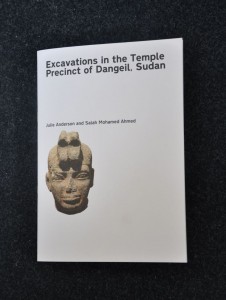
This recently published eBook by Julie Anderson and Salah Mohamed Ahmed describes the progress of the Berber-Abidiya Archaeological Project in Dangeil, Sudan. Julie is Assistant Keeper of Sudanese and Egyptian Antiquities at the British Museum and Salah works for the National Corporation for Antiquities and Museums, Sudan and the eBook was written for a conference Julie attended. It was then printed at A5 size using the bookleteer Publish and Print on Demand. Download the A3 / Ledger PDFs here.
The eBook is full of rich details about the site in Dangeil (which sounds huge – 300x400m) and the remarkable and beautiful statues and buildings they’ve uncovered there. Intriguingly the site consists of several mounds covered with fragments of red bricks, sandstone, pot shards and plaster and each mound represents a well-preserved ancient building. It’s even possible to see traces of colour left on the stones.
As well as describing the buildings there are also fascinating insights into the rituals, food, rulers and everyday life of the temple, including the information that the Kushite language, Meoitic Meroitic, is one of the few remaining languages in the world which has not yet been translated. And running all through the book are casual glimpses into the detective work of the archeologist.
The idea is that Salah will now translate the eBook into Arabic so it can be distributed to schools around the archeological site to help them understand what’s going on and what has been uncovered. Which would be very exciting for bookleteer because that would allow us to produce our first eBook using the Arabic font and right-to-left reading that we worked so hard to include!
I took the photo above in the Kenrokuen gardens, Kanazawa. We were standing beside the lake at the centre of these beautiful and historic gardens when I saw these two ladies. Standing side-by-side one lady was sketching what she could see using a pencil and paper notebook, the other was using her mobile phone to photograph the same view.
I was reminded of this picture when I read this post suggesting that pen and paper are mightier than the laptop. It describes a meeting of high-powered business men in which paper notebooks outnumbered the electronic version. The blog author, David Hornik, describes what he sees as the advantages of a paper notebook.
“Notebooks have certain enviable characteristics. They are instant on — even faster than a laptop with a solid state drive. They have virtually unlimited storage — just boot a new notebook when the pages are filled. And they perform better than tape for archival storage. Direct sunlight is no problem for a bright white piece of paper. And power management is rarely a problem (although your pen may run out of ink). Notebooks don’t require any connectivity. They aren’t susceptible to viruses. And they are highly portable. [1]
[1] I realize Notebooks aren’t perfect. They perform about as well as laptops when exposed to the elements. They are a terrible collaboration tool. And I have yet to see an effective way to backup your notebooks.”
Obviously, this is a relevant topic for bookleteer which uses digital processes to produce paper notebooks and it got me thinking – what are the pluses and minuses of paper vs computer notebooks?
I love my laptop but I don’t carry it more than I have to because it’s heavy (well, heavier than a paperback book), it’s precious – I don’t want it stolen or lost, and it contains *everything* – I don’t want my photos, dissertation, emails, music and to-do lists destroyed by a wayward cup of tea! On the plus side it contains *everything* and I never find I’ve left something important at home. My paper notebooks, on the other hand, are lightweight and tend to be more focused – a work notebook, a sketchbook, a project notebook.. And they hold stuff too – flower petals, tickets, business cards and so on. They’re still vulnerable to a spilt cup of tea but the consequences are probably not so serious.
So perhaps it’s not so much about ‘better’ or ‘worse’ but about being the most appropriate object for the situation or person.
What do you think? Do you prefer paper or computer notebooks? Any opinions welcome..