Photographs of Macleods secondhand bookstore, Vancouver, Canada and a bookshelf, from bookshelfporn.com
As if to emphasise James Bridle‘s point that books-as-objects act as souvenirs of the reading time, a few days ago I came across the blog bookshelf porn. The premise of the blog is simple – it shows photographs of bookshelves, contributed by readers, and adds a new picture of two every day. But I never would have imagined the variety of book shelves that exist, or how beautiful they look when they are collected together in this way.
This isn’t all about aesthetics – this is a blog with a message. While there’s very little text on the site occasionally, in between the photographs, there is a quote such as this one from The New Yorker’s The Book Bench writing about Bookshelf porn:
“Featuring a book on your bookshelf is akin to displaying a trophy. You’ve accomplished something in reading a book; it feels like a victory. The opportunity to display your literary conquests in unique or unexpected ways is something I will greatly miss with e-readers.”
This message – that bookshelves have a beauty and purpose that is not found in e-readers – is carried across the site. And looking at the photos I couldn’t really argue with that, however, I am excited to see how e-readers might begin to address that challenge…
Art Space Tokyo is an intimate guide to the Tokyo art world by Ashley Rawlings and Craig Mod and a very beautiful book describing the buildings and neighbourhoods of 12 distinctive Tokyo galleries. There are maps for each of the areas, illustrations of the galleries by Nobumasa Takahashi (the cover is a composite map of Tokyo by Craig Mod) alongside interviews and essays.
Inside pages from Art Space Tokyo
In the Preface to Art Space Tokyo Ashley and Craig write:
“We believe that art is not just an end goal, but a process involving all manner of people. Aside from the artists themselves, the art world is made up of collectors, curators, architects, businessmen, npo organizations and the patrons — those of us who gain pleasure from simply viewing and interacting with art — all taking part in some way to foster the creation and consumption process.”
Although here they were referring to the people who work in and with galleries and art they also applied this philosophy to the creation of Art Space Tokyo. Originally printed in 2008 the book was sold out by Spring 2009. In 2010 Ashley and Craig decided that they would like to update and reprint the book as well as create a free web edition for the iPad extending the original concept with videos of the spaces and interviews with local characters, sound-recordings that reveal the ambience of the neighbourhoods and rich interactive maps.
Illustration for GA Gallery, Yoyogi / Harajuku
In the spirit of shared making, it was at this point that they turned to Kickstarter as a way to raise the money necessary to achieve their goal. Kickstarter allows people to advertise their project and ask for contributions towards realising it. Requested contributions for any project range from a few dollars to a few thousand dollars – with your reward increasing alongside your contribution. For example, a pledge of $25 Art Space Tokyo would have got you a PDF of the book plus access to all project updates. At the other end of the scale for a pledge of $2500 you would have received all of the rewards of the other pledge amounts (e.g. copy of the book, original artwork) plus a 1-day tour of the art spaces of Tokyo with Craig Mod.
Is this shared making? Well, yes, I think it is.. As they write in the preface art – or making – is a process not just a product and through Kickstarter Ashley and Craig were offering the opportunity to become part of this process. And I hope the benefits were mutual – they got to reprint the book, contributors got a tangible reward (and presumably a warm fuzzy feeling from helping out two artists).
p.s. If you were thinking of contributing you’re too late… Ashley and Craig wanted $15,000. By 1 May when the pledges closed they had 265 backers and had raised $23,790!
Sharing Goods – the hardest to do, because if you give a physical good you no longer have it, you’re deprived of it.
Sharing Services – like giving helping someone across the road – you don’t lose out on physical stuff but it’s an inconvenience.
Sharing Information – like giving someone directions – you don’t lose stuff, it doesn’t take much time, no inconvenience.
Also interesting are Russell’s further thoughts on this where he discusses the relative value of mixtapes vs playlists and how the tangibility of mixtapes actually increases their value.
I find this an incredibly useful way to think about sharing in relation to bookleteer. Give away a printed eBook or StoryCube and you lose that object – but the person you give it to feels valued as a result of that exchange. Email someone an eBook or StoryCube and you don’t lose anything except the time it takes to write the email – but the value may be diluted as a result. Sometimes you won’t have a choice about which way you distribute your eBooks (see A Little Something About Me for one example of why this might be) but when you do the question to ask might be – how do you want the recipient of your eBook to feel..?
This was the question I typed into Google as I wondered how the iPad, Kindle and other eBook readers (or rather, developers of eBooks for these platforms) might accommodate the tangible properties of books such as size, paper type, pop-up illustrations and so on, that vary from book to book and make paper books such a pleasure to touch, hold and feel.
In answer to my question Google came up with a couple of examples of projects that claim to be bringing pop-up books to the iPad. The first is Pilgrim’s Progress by Tako Games. Although entirely computer-generated the video that accompanies this eBook suggests that Pilgrim’s Progress combines moving around a 3-dimensional scene that closely resembles a paper pop-up book (the ‘cover’ of the book is a very literal digitisation of an antique leather book) with some dynamic elements such as changing text within the text box. I found it difficult to tell from the video how much of this would be controlled by the reader.
The second suggestion by Google was Alice in Wonderland by AtomicAntelope. While clearly drawing on pop-up books for inspiration this feels like it is also pushing the format into new areas by exploiting the touchscreen to trigger events and, quite beautifully, using the built-in accelerometer and orientation sensors to control visual effects such as flying cards, Alice growing and shrinking and rocking the pigbaby to sleep.
While I have to confess that watching the Alice in Wonderland video made me wish I owned an iPad so I could play with this, I also wonder – if every book feels like an electronic device then, however visually compelling the eBook, won’t this somehow feel like a sensory reduction of the reading experience?
I’m not sure if Choose Your Own Adventure books count as shared making or shared reading (or both?) but I would certainly claim it as an augmented reading experience. The Choose Your Own Adventure series of children’s books was published by Bantam books between 1979 and 1998, however, the format was used for several other series of books including Fighting Fantasy (which was the Choose Your Own Adventure books of choice for my brother and I when we were kids).
In case you’ve never come across them, the premise is that you – the reader – take the role of protagonist in the books and at the end of each short section of narrative you are presented with a number of options representing your next actions. For example, in The Cave of Time, the first choice you are required to make is:
If you decide to start back home, turn to page 4.
If you decide to wait, turn to page 5.
Turning to the page for your chosen option the narrative continues, eventually leading to one of multiple different endings. Like I said, my brother and I read these a lot as kids and while the narratives tend to be quite similar and the range of options can be frustrating (“But why can’t I throw my frying pan at the King of the Ants?!”) they were also truly engaging as we tried to figure out the potential consequences of our actions.
Of course, the branching structure and constrained options translate easily into computer programs and computer games might be seen as the multimedia, all-bells-and-whistles version of Choose Your Own Adventure. In my current reflection on the nature of books though I begin to wonder if the format of these books creates a different experience for maker/readers? For my brother and I these books were very definitely a collaborative experience – just as computer games can be – but they are also slower paced and with the opportunity to take a sneaky look ahead and see what happens if you choose a particular path. While I wouldn’t say that Choose Your Own Adventure books are more engaging than computer games (we gave them up around the time we got our first computer..) I think they might offer a unique type of reading – constructive, collaborative and accountable.
A set of Bookcubes generated using the bookleteer API
James Bridle of booktwo.org was one of the participants at the Pitch Up and Publish: Augmented Reading a couple of weeks ago, and he talked a little about the idea of books as symbols and the related BookCube project he’d done using the bookleteer API.
Here, I’ll just give a summary of the project. James has written a post on booktwo.org describing the project which I really recommend you to read because it’s seriously interesting and covers more topics than I describe here…
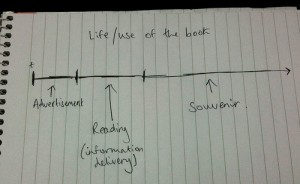
James started with the idea that the lifespan of a book looks something like the drawing in the image above. There is a short period of the book-as-object acting as it’s own advertisement, then a period of time where you are reading the book and taking in the content, then during the final, and longest, amount of time the book-as-object acts as a souvenir of the reading period.
James has already begun to address the idea of digital souvenirs for eBooks with his bkkeepr project and with the bookleteer API he extended this to create automatically generated Bookcubes. These cubes display the information collected by bkkeepr and includes an image of the book cover. Over time James imagines the Bookcubes to build up on your shelf as a visible and tangible souvenir of your eBook reading. For bookleteer, this is an interesting tangent – instead of being an object to read it becomes an object that marks the fact that reading has taken place – and the content becomes separated from the form.
Yesterday I wrote about Storybird and how it enables a form of shared making through an online interface using email to notify authors when it is their turn. This reminded me of a very definitely non-technological example of the shared making of books..
Making the Oxford English Dictionary
From when the gargantuan project of compiling the Oxford English Dictionary began in 1857 it would take 71 years until the first edition was published. The third editor, James Murray, worked on the project for 36 years but died before he saw it completed. As part of his tasks Murray oversaw hundreds of volunteer readers and contributors who would painstakingly search out early examples of the use of words and send them to Murray by post. As a result of this mail-enabled shared making method, the first Oxford English Dictionary contained 414,825 words, and 1,827,306 illustrative quotations.
Contributors were not all academics and linguists. J.R.R. Tolkein was a volunteer while one of the most notorious, and prolific, contributors was Dr W. C. Minor, a murderer and certified inmate of Broadmoor Criminal Lunatic Asylum. Confined at Broadmoor with his collection of rare books, Minor happened upon Murray’s call for ‘men of letters’ to become Oxford English Dictionary volunteers in the early 1880s and began scouring his collection for the first or best uses of words.
If the project took place today it would almost certainly be termed a ‘crowd-sourcing’ project and would be built as a wiki (see en.wiktionary.org/wiki/). What does this non-digital shared making project suggest? That times change, technologies move on but ideas remain the same, or perhaps that we shouldn’t let technology get in the way of carrying out a good idea..?
Storybird is a website where you can create your own online illustrated storybook. Aimed at children from 3 – 13 books can be created collaboratively and they positively encourage families, friends and school classes to work together. The artwork for your stories is provided by illustators and visual artists who are able to upload their drawings to the site. Making a Storybird is free though they plan to charge for their printing service when it starts later this year. You can browse by artwork or themes as inspiration to start your book and I have to say I like the look of the site and the illustrations very much.
When collaborating on a Storybird each person can jump in and make changes any time they like, however, they have also put together a more formal collaboration process based on turn-taking. One person starts the Storybird and when they want to pass over to their friend they let Storybird know and an email will be sent to their friend telling them it is now their turn. Storybirds can be kept private or published to the library when complete so that other people can share it too.
As I said, I love the look of the site and the illustrations they currently have in the library. It seems it would be difficult not to create a visually beautiful book from these pictures – and I imagine you can upload your own artwork if you want to illustrate your own stories. Storybird suggests that contributing artwork to Storybird has several benefits for artists including making money from your work. However, I’m unclear how this happens when making a Storybird is free… (If you find out please do let me know!)
How does this relate to bookleteer eBooks? I think it’s interesting that the Storybird exists only as an electronic online storybook (at least for the moment) and I don’t find that this detracts from the reading experience – though perhaps I’d feel differently about this if I was reading with a child, or group of children. On the other hand I can also imagine that if I was a child and had created my own Storybird that I would love to see it printed out as a proper little book that I could take home and show my family and friends. I wonder what it is about tangible, hold-able items that makes them feel so personal and intimate compared to things on a screen?
While Alice was out getting lunch I took some sneaky photos of the 3-dimensional illustrations she’s been working on. The drawings for these come from the ones made in Brixton and Coventry for the Empty Shops Network tour. Parts of them have then been cut out, folded and re-attached to give a diorama feel.
I’d love to see my pop-up eBook experiments and Alice’s drawings come together some day to create a colourful hand-drawn eBook pop-up extravaganza.
“Software is rarely written in a vacuum and indeed the “open source” movement is built on the premise that collaboration is the only way to get bugs spotted and move forward. Scientific research, too, is more often than not a collaborative activity – and peer review is key to checking and honing the development of scientific ideas.
However, is the same true in artistic fields? We are used to the romantic notion of the artist or the novelist working alone in an attic room, or in the shed at the bottom of the garden. As James Joyce memorably put it, the artist forges in the “smithy of [his] soul”. Yet many of the most highly regarded television programmes of recent years are written by teams of writers; and the majority of films go through rigorous screen testing exercises (and are often altered as a result) before they reach the paying customer. The painters Holbein and Titian, among any number of their contemporaries, used students to add the detail to their pieces before signing them, a tradition continued to this day by Damien Hirst who openly acknowledges the contribution of his studio team.
But what about the novel? Can a collective create a believable fictional voice? How does a plot find any sort of coherent trajectory when different people have a different idea about how a story should end – or even begin? And, perhaps most importantly, can writers really leave their egos at the door?”
And so it began – Penguin’s 2007 experiment into the online collaborative novel. I came across the A Million Penguins project as I begin my investigation into sharing the making of books or in this case, a novel. Penguin set up a wiki where authors could contribute, edit and delete a collaborative novel. You can read the novel – and about the process that went through – at www.amillionpenguins.com.
On the Institute for the Future of the Book blog there is an insightful and analytic post by Ben Vershbow discussing the merits of the project as an idea and as a novel. Ben concludes that a wiki is probably the wrong format for the online collaborative novel. So if not wiki – what?