Categories
inspiration making

Shared making of the Oxford English Dictionary

Yesterday I wrote about Storybird and how it enables a form of shared making through an online interface using email to notify authors when it is their turn. This reminded me of a very definitely non-technological example of the shared making of books..


Making the Oxford English Dictionary

From when the gargantuan project of compiling the Oxford English Dictionary began in 1857 it would take 71 years until the first edition was published. The third editor, James Murray, worked on the project for 36 years but died before he saw it completed. As part of his tasks Murray oversaw hundreds of volunteer readers and contributors who would painstakingly search out early examples of the use of words and send them to Murray by post. As a result of this mail-enabled shared making method, the first Oxford English Dictionary contained 414,825 words, and 1,827,306 illustrative quotations.

Contributors were not all academics and linguists. J.R.R. Tolkein was a volunteer while one of the most notorious, and prolific, contributors was Dr W. C. Minor, a murderer and certified inmate of Broadmoor Criminal Lunatic Asylum. Confined at Broadmoor with his collection of rare books, Minor happened upon Murray’s call for ‘men of letters’ to become Oxford English Dictionary volunteers in the early 1880s and began scouring his collection for the first or best uses of words.

If the project took place today it would almost certainly be termed a ‘crowd-sourcing’ project and would be built as a wiki (see en.wiktionary.org/wiki/). What does this non-digital shared making project suggest? That times change, technologies move on but ideas remain the same, or perhaps that we shouldn’t let technology get in the way of carrying out a good idea..?

Categories
inspiration

Storybird – collaborative storytelling

Storybird is a website where you can create your own online illustrated storybook. Aimed at children from 3 – 13 books can be created collaboratively and they positively encourage families, friends and school classes to work together. The artwork for your stories is provided by illustators and visual artists who are able to upload their drawings to the site. Making a Storybird is free though they plan to charge for their printing service when it starts later this year. You can browse by artwork or themes as inspiration to start your book and I have to say I like the look of the site and the illustrations very much.

When collaborating on a Storybird each person can jump in and make changes any time they like, however, they have also put together a more formal collaboration process based on turn-taking. One person starts the Storybird and when they want to pass over to their friend they let Storybird know and an email will be sent to their friend telling them it is now their turn. Storybirds can be kept private or published to the library when complete so that other people can share it too.

As I said, I love the look of the site and the illustrations they currently have in the library. It seems it would be difficult not to create a visually beautiful book from these pictures – and I imagine you can upload your own artwork if you want to illustrate your own stories. Storybird suggests that contributing artwork to Storybird has several benefits for artists including making money from your work. However, I’m unclear how this happens when making a Storybird is free… (If you find out please do let me know!)

How does this relate to bookleteer eBooks? I think it’s interesting that the Storybird exists only as an electronic online storybook (at least for the moment) and I don’t find that this detracts from the reading experience – though perhaps I’d feel differently about this if I was reading with a child, or group of children. On the other hand I can also imagine that if I was a child and had created my own Storybird that I would love to see it printed out as a proper little book that I could take home and show my family and friends. I wonder what it is about tangible, hold-able items that makes them feel so personal and intimate compared to things on a screen?

Categories
inspiration

Sneaky Peek at Alice’s Desk

While Alice was out getting lunch I took some sneaky photos of the 3-dimensional illustrations she’s been working on. The drawings for these come from the ones made in Brixton and Coventry for the Empty Shops Network tour. Parts of them have then been cut out, folded and re-attached to give a diorama feel.

I’d love to see my pop-up eBook experiments and Alice’s drawings come together some day to create a colourful hand-drawn eBook pop-up extravaganza.

Categories
inspiration

Can A Million Penguins be wrong..

“Software is rarely written in a vacuum and indeed the “open source” movement is built on the premise that collaboration is the only way to get bugs spotted and move forward. Scientific research, too, is more often than not a collaborative activity – and peer review is key to checking and honing the development of scientific ideas.

However, is the same true in artistic fields? We are used to the romantic notion of the artist or the novelist working alone in an attic room, or in the shed at the bottom of the garden. As James Joyce memorably put it, the artist forges in the “smithy of [his] soul”. Yet many of the most highly regarded television programmes of recent years are written by teams of writers; and the majority of films go through rigorous screen testing exercises (and are often altered as a result) before they reach the paying customer. The painters Holbein and Titian, among any number of their contemporaries, used students to add the detail to their pieces before signing them, a tradition continued to this day by Damien Hirst who openly acknowledges the contribution of his studio team.

But what about the novel? Can a collective create a believable fictional voice? How does a plot find any sort of coherent trajectory when different people have a different idea about how a story should end – or even begin? And, perhaps most importantly, can writers really leave their egos at the door?”

And so it began – Penguin’s 2007 experiment into the online collaborative novel. I came across the A Million Penguins project as I begin my investigation into sharing the making of books or in this case, a novel. Penguin set up a wiki where authors could contribute, edit and delete a collaborative novel. You can read the novel – and about the process that went through – at www.amillionpenguins.com.

On the Institute for the Future of the Book blog there is an insightful and analytic post by Ben Vershbow discussing the merits of the project as an idea and as a novel. Ben concludes that a wiki is probably the wrong format for the online collaborative novel. So if not wiki – what?


not quite a million penguins (via penguinsland.blogspot.com)

Categories
publishing on demand

Oh! The Places You’ll Go!

My original time for working on bookleteer was up last week so I thought I’d write a little round-up of my highlights of that time.

I set out to think about books-as-objects and explore the tangible qualities of bookleteer eBooks and StoryCubes. This gave me the perfect excuse to research and write about all kinds of paper artists who make the most fantastic books involving cut-outs and pop-ups and flip books. Then, being naturally inclined towards the technological I also looked at where electronics and paper combine and the kinds of reading experience this leads to.

It was at this point that I set about making the first pop-up eBook. Of course, this was more difficult than I first imagined (though the pop-ups were easy enough to do..) and the book is currently in an almost finished state waiting for me to be hit by inspiration on how to include the instructions without it turning into a 120-page eBook (even if that was possible!)

Next I began to wonder what all of these technological, tangible, paper pop-ups and cut-outs had in common and I came up with the idea that they all augment the reading experience – using form, movement and interaction to go beyond text. The outcome of this conceptual wandering was the Pitch Up & Publish on Augmented Reading where I met fabulous folk who were already thinking about this area and who challenged and inspired me.

So here we are… And where do we go?

Giles has asked me to do another couple of months on bookleteer so I’m currently thinking of where to take the projects I’ve begun so far. Completing the pop-up eBook is an exciting practical challenge and gives me the perfect excuse to browse more websites and blogs by paper artists. Alongside this I’m planning to explore the broader role of books-as-objects – a topic that came up in the Pitch Up & Publish. This might mean thinking about books as symbols of knowledge, identity, or markers of reading achievements. Another strand I’ll follow will look at sharing – sharing the making and sharing the reading. I’m not sure where this will go yet but if it’s anything like the last couple of months it’s going to be an interesting journey…

Categories
inspiration

Alice Angus: 12 Month Schedule

This 12 Month Schedule by Alice is my new favourite eBook. It has one month per page with pages for notes  and every page is decorated with illustrations by Alice. It’s designed as a notebook to carry around and use as a way to keep yourself organised, jot down ideas or make sketches. But seriously, could you bring yourself to write on top of Alice’s amazing drawings??

Cover image (from In Good Heart series)

The Schedule eBook can be downloaded at diffusion.org.uk. And if you have access to an A3 printer then you are even luckier because you can make it up at the new A5 size and enjoy the illustrations at twice the size (or have twice the room for making notes..).

If you want to see more detail of the pictures check out Alice’s Flickr stream.

Categories
inspiration

Access Art: The Scrappy Sketchbook

bookleteer eBooks have often been used as sketchbooks or notebooks for people to draw or write in (as seen in yesterday’s post on ‘A Little Something About Me‘!) and one of the things I love best about them is that they are such a manageable size and look so handmade that it’s almost impossible to feel intimidated by the ‘blank white page’ and feel that your ideas are not going to live up to the notebook.

And now I find that Access Art understand precisely how a sketchbook can be a constraint as well as an inspiration! In Sketchbook Space, amongst all of their fabulous examples of sketchbooks, ideas for sketchbook activities and answers to the question ‘When to use a sketchbook’, they also provide the Scrappy Sketchbook. This is a 13 page PDF to download with a title page and 12 ‘blank’ pages each with an image of a different type of paper or surface. Download the PDF, make up the book using hole punch and string and you have a ready-made scrappy sketchbook that is totally blank and completely filled in – at the same time! You’ll never need to feel intimidated by the blank page again..

Some of the pages from the Scrappy Sketchbook

Of course, if it seems too much trouble to get out the hole punch you could always upload the PDF to bookleteer and generate it as an eBook, then all you need are scissors to complete your scrappy sketchbook.

Read more about the Scrappy Sketchbook and download the PDF here..

Categories
examples

Bev Carter: Umulogho -> Watford


Schoolchildren in Umulogho; Schoolchildren in Watford

Writing yesterday about the importance of the tangible paper form of bookleteer reminded me of the A Little Something About Me project by Bev Carter carried out in 2007 – 2009 as part of Proboscis’ Generator Case Studies Residency Programme.

Bev wanted to make connections between her local school in England and the schoolchildren in Umulogho village, Imo state, Nigeria and the eBooks provided her with a way to do this.

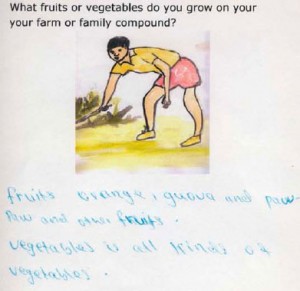
The first eBook of the project, ‘A Little Something About Me‘, contained paintings, pictures and information by the students of the local school in Umulogho. The children were asked to write ‘a little something about me’ describing what learning meant to them, their hopes, fears, likes, dislikes etc. These eBooks were brought back to the UK and taken into Bev’s local school where the British children read and responded to the Umulogho eBooks helping to devise the questions for a second eBook called ‘Kedu? How Are You?‘ which was made online then printed out and sent out to Umologho early in 2008.


From Kedu? How Are You? eBook: Questions about Umulogho by British schoolchildren illustrated with pictures by students in Umulogho from the A Little Something About Me eBooks

The ‘Kedu? How Are You?‘ eBook (Kedu means ‘How are you? in Igbo, the main language spoken in Umulogho Village) was designed as a notebook to be completed by the children in Umulogho, responding to questions asked about them and their lives by British schoolchildren. Filling in the eBook also enabled the children of Umulogho to ask questions of the children in Watford such as ‘what seasons do you have in England?’ and ‘what religions do you have?’


Response to the Kedu? How Are You? eBook by students in Umulogho

In October 2008 the completed Kedu eBooks were taken back to the school in Watford that had asked the original questions. The students were delighted to see the answers to their questions, such as ‘are there any crocodiles in the village stream?’ (some Umulogho students had seen some and others hadn’t) and got the students talking about the differences between the everyday lives of the Umulogho children and their own – for example, what time they wake up in the morning and what they do before school as most students in Umulogho were awake by 5.30 am and had gone to the village stream and back to collect water before going to school.


Response to the Kedu? How Are You? eBook by students in Umulogho

Even though the school in Umulogho doesn’t yet have a computer or internet access, it was still possible to send and receive paper copies of the eBooks, and by scanning in the completed eBooks the results could be shared online. In this way a conversation was able to be held across continents, cultures and technological formats.

Read more about the project and download the Umulogho eBooks at diffusion.org.uk

Categories
inspiration

Battle of the Reading Formats


An iPad disguised to fit in on a book shelf. * See the bottom of this post for more.

Fitting in very nicely with our discussions on Augmented Reading, Jakob Nielsen, the legend of usability studies, has conducted a test on the relative reading experience of reading a short story (Ernest Hemingway, in case you’re interested) on the iPad, Kindle eReader, PC and printed book.

Twenty-four participants read the story in each of the different formats. On average the story took 17 minutes 20 seconds to read however both the Kindle and the iPad came in slower than the printed book by 10.7% and 6.2% respectively.

In terms of user satisfaction, readers were asked to score each of the formats on a scale of 1-7 with 7 being the highest score. The iPad, the Kindle and the printed book all recorded similar scores (5.8, 5.7 and 5.6 respectively) all of which were significantly higher than the score for the PC at 3.6.

In their comments participants said they found the printed book more relaxing than any of the eReaders and that the PC reminded them of work. I guess Carlton hadn’t seen this study when they launched their AR books for children – to be experienced on a PC.

However, it’s also good news for eReaders and suggests that they no longer offer a worse reading experience than printed books and that in the end your choice of reading format might come down to personal preference as in the case of music listening where, despite the ease of CDs and MP3s, some people still prefer to listen to music on vinyl. This is another conversation I had at PU&P: Augmented Reading where I was discussing the topic of choice and formats with the guys from getmorelocal.co.uk in the context of trying to reach people who might not be inclined to go online to look for information. Indeed, this was one of the motivations behind the tangible format of bookleteer eBooks.

Read more about the study on Jakob Nielsen’s Alertbox. Found via the Guardian.

* The Book for iPad by Longlivebooks via Design-Fetish and seen on a bookshelf at the top of this post

Categories
inspiration

Carlton say Books Come Alive

New Scientist reports that UK publisher Carlton have launched two titles in their Augmented Reality series. The books – Fairyland Magic and Dinosaurs Alive – include a CD with software to install on your PC. Once this is done you point your webcam at the pages of the book and the webcam image of the book displayed on your computer monitor is augmented with hand-drawn, moving fairies or dinosaurs. The New Scientist article does a great job of describing the perceived need for books to embrace technologies and the potential complications resulting from this. You can also watch Carlton’s video promoting Fairyland Magic on YouTube.

I find the books interesting in the context of a discussion we had at the Pitch Up & Publish Augmented Reading last week when David suggested that interactive digital content of this kind (we weren’t talking about the Carlton books at the time) diminishes the experience of reading rather than augmenting it. David’s argument was that adding screen-based computation to a book imposes rules and restricts interaction in a way that a paper-and-ink book doesn’t.

Books Come Alive seem a good illustration of this argument as the book has to be in proximity of the computer screen and webcam in order to create the digital images. This sets up what seems to me to be a quite unnatural reading position as the priority becomes orienting the page to the webcam. Instead of reading being an intimate experience between one person and a book this opens it up to a wider audience for whoever happens to be in sight of the computer monitor. I wonder what the effects – good or bad – will be of this?