These extraordinary creations are individually handmade by Stephanie Anderson, cut from paper and card. Each zine is a different burger with varying paper ingredients, and is limited to 20 copies. I suppose these are as far away from the typical imaginings of what a zine is, but innovation and creativity do tend to rock the boat.
These zines are tiny – no larger than a 10¢ piece. Apparently these are the smaller versions of Stephanie’s original Hamburger zine.
It would be great to create similar things by publishing an eBook with various ingredients that just need to be cut out and coloured in, then assembled. A cookbook for paper food – each page a different dish!
Le Dot is an A6, 12 page, black and white zine by Anthony Zinonos. Each page has a clipping from an old photograph, and an orange dot sticker placed in somewhere that interacts with it in a comical way. It’s such a simple idea, but it works surprisingly well. I love how the sparse white background contrasts strikingly with the glaring orange dots, and highlights how alien they look compared to the black and white images, yet they still fit so perfectly. It was also easy to make it seems; just photocopied and stapled.
Another zine by Anthony, “theBLUEbits”, works in a similar idea; this time sticking hand cut pieces of blue paper with the images.
These have got me thinking about how easy it would be to make similar zines with bookleteer. Readers could download the base eBook, then customise it with their own materials, or a separate downloadable sheet with pre-designed shapes. Pop-up zines could also be created, in the same way that Mandy’s Tangled Threads eBook had a page with cut-out inserts and instructions. Swapping these around with other readers would be great, to see how many variations on a single template could be found.
Last Friday we had our first Pitch In & Publish: City As Material session at the Proboscis studio, “Streetscapes”. In attendance were Giles Lane, Tim Wright, Anne Lydiat, Fred Garnett, David Jennings and myself. After some introductions and hearing participants particular interests, we started pitching, planning what we would like to see in our collaborative publication. Many ideas were inspired by personal projects, but the group soon gave birth to to some new, exciting concepts, (as well as a debate about when the first pineapple was grown in Britain) and after a brief interval of lunch to refuel, we set off to wander through the City.
From Smithfield we walked through Charterhouse Square, onto Aldersgate, and then into the Golden Lane estate. We must have resembled a tourist group; eyes skyward as the history of our surroundings was recounted by those who had tales to tell. By accident we stumbled across an unusual circular space, at odds with the towers of the estate. A haven to rest and exchange stories, we soon discovered the unusual acoustics of the circle, and formed a ring in the centre to test them. Tim recorded this unusual ritual, which you can view here, and David has also posted an audio clip, which you can listen to here.
We then headed through the Barbican, and into Postmans Park to read the plaques that form the “Memorial to Heroic Self Sacrifice”, poignant tributes to those that have died attempting to save others. This was an amazing place, one I had never visited before, and it served as a perfect end to our expedition.
Once back at the studio, and after numerous teas, coffees and fig rolls, we started to form our publication. We decided the brick circle in the middle of Golden Lane estate, which we deemed the “Unplace”, would be our focus – the eBook chronicling our journey there, and our experience within. Thus, the “Unbook of Disappropriation: Situated Moments From The City” was created. We liked the concept that this eBook would not just be inspired by the city, but that we would add to it as well, so we included a blank page for readers to write down their own experiences of the Unplace, then tear it out and leave it someone else. There is also a City As Material group on Flickr, and two hashtags on Twitter – one general – #cityasmaterial, and one for Streetscapes – #ddiof, so we can continue the discussion.
Our next Pitch In & Publish: City As Material event, on the 29th of October, will be based on the theme of “River”, and our special guest will be Ben Eastop. Book a place here.
This Friday is the first of our Pitch In & Publish sessions based around the theme of City As Material, “Streetscapes”. For those who are already taking part, and for those who might like to, I thought I would break down the structure of the day, and list anything people might want to bring.
It’s best to arrive around 10:00 am, as we’ll be starting at 10:30. The first part of the morning will introductory, explaining City As Material, as well as our aim’s and background. Then we’ll be inviting everyone to get to know each other, and letting our special guest Tim Wright talk about his interest in the topic. We’ll then find out what people want to create, and any specific areas of the publication they would like to concentrate on, as well as planning any trips out around the area to gather inspiration and materials. Thus, commence creating!
I stumbled across this gem when following an excellent Zines page on Facebook, run by Alex Zamora of Fever Zine. An A5, 15 page, black and white illustrated Zine by the Lindström Effect collective, “HADRÖN” is a mock instruction manual for the Large Hadron Collider, in the style of IKEA furniture instructions.
The comical idea of using a self-assembly furniture guide for one of the most expensive and complicated scientific experiments ever is ludicrously funny, and it works so well as the diagrams and typefaces are spot on; there’s even a CERN logo in the vein of IKEA’s. I’ve never had to assemble any IKEA furniture, but I’ve heard many tales of frustration from those that have – the LHC might have turned out very differently if the engineers had followed this guide (I’m sure the Lindström Effect might even cite personal experience as inspiration for this Zine).
Whilst researching the zine scene, I’ve noticed there seems to be a distinct lack of literary and poetry zines being produced, which pains me as they are my primary loves. It seems odd, as the popularity of the zine owes a lot to the short, self-published books of poetry and prose by the beat generation, known commonly as “chapbooks”. These enabled anyone to distribute their work without the aid of a publisher, which would sometimes be impossible with the strict censorship and decency laws of the time. This D.I.Y spirit is the driving force of the zine community today, but the focus has shifted onto more visual outputs; inevitable with modern printing capabilities and the vast amount (and talent) of illustrators and graphic designers involved in the scene.
There was a lot of interesting points raised during a recent meeting with The Poetry Society, one being the difference between publishing online on a personal blog, and being part of a publication with a bigger picture. Whilst promoting the Pitch In & Publish series of events, I’m hoping writers in particular get involved, as bookleteer has a lot of potential for those who may not be blessed with a wealth of design skills or self-publishing know-how, and being featured in the collaborative zines produced should definitely build budding writers confidence.
Over the next few months we’ll be hosting a series of one-day zine making events at the Proboscis studio, entitled “Pitch In & Publish”, where anyone can take part in making a collaborative zine using Bookleteer. The first series will be based on the theme of “City As Material”, explained below by Giles.
“The city has increasingly become not just a stage for creative activities to be presented on but also the material with which creative works are made. Its flows and fabric are now rendered legible by new technologies and social participation that in turn foster diverse conceptions of citizenship and inhabitation. These processes highlight the mutability of “public” and “private” and the sometimes subtle, sometimes swift transformations of social space.
This series will comprise collaborative publications that investigate, intervene within, project upon and play with the notion of the city as material. Each of the events we host will focus around a specific topic as a sight-line for a cross-section, a lens through which to perceive a layer of investigation or framework to play within.
We invite you to join us in a collaborative attempt to peer beneath the surface of the city and explore the forces shaping and shaped by the urban fabric, its inhabitants and energies. In addition to a collaborative publication produced around each topic, we will be encouraging all the participants to create their own personal publications to add to the series.”
Each issue will be inspired by one of these topics: Streetscapes, River, Skyline, Underside and Sonic Geographies.
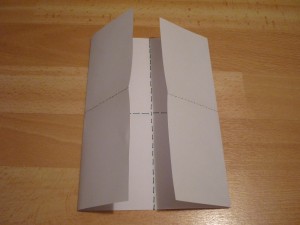
I’ve been focusing on zines with unconventional formats recently, so I thought I would go the reverse way, and share a simple, traditional method of making a mini-zine from a single sheet of paper, with no glue or binding methods needed, just like Bookleteer. I’ve used A4 in this example, which makes a tiny 8 page booklet, perfect for short comics; each page is around the same size as a traditional comic book panel. You can make a 16 page book if you use both sides, but the reader needs to unfold and reverse the paper to read it all.
Start by folding the sheet of paper in half lengthways, then unfold and fold in half the short way, so the creases are along the dotted lines as shown above.
Then fold the edges in towards the center crease, and unfold. There will now be eight panels on the sheet, each one a page.
The bottom left panel will be your back cover, the next along your front cover. The layout of pages one through six are outlined above. Create your work on this template, then photocopy, or scan and print copies, and fold each sheet in the exact same way as the template.
To assemble, cut a slit lengthways along the middle, spanning two panels, as shown. You can use a scalpel, or simply fold the paper in half and cut the length of of one panel with scissors.
Fold the sheet lengthways so the bottom panels are in front, and bring the edges in so it takes the shape of a book.
Although the new digital age has made making a zine incredibly easy, especially with tools such as bookleteer, I thought I would take a look at the other end of the spectrum; handmade zines. Many still continue to design and assemble their zines by hand, some eschewing a computer entirely, simply photocopying pages, or even reproducing every copy by hand, often resulting in some amazingly intricate and unique creations. This opposition to the digital format seems to inspire a much more elaborate aesthetic, and many zines would be impossible to recreate digitally, save for the new wave of pop-up e-Books and iPhone apps, recently featured by Karen.
… and pretty much everything else in the handmade section on Book By Its Cover. Beautiful.
Obviously, the only way to distribute these is by hand or post, and therefore swapping zines with other makers is a staple of the scene. Knowing firsthand the amount of care and skill that has been lavished on these, surely adds another level of appreciation for the work, something I doubt sending an eBook zine could match, sadly. I’ll be writing about the impact the digital format has had on the zine aesthetic, and how they are shared, soon.
Hello! I’ve been at Proboscis for just over a month now, under the Future Jobs Fund placement scheme. I’ll be contributing regularly to the Bookleteer blog during my time here, mainly topics relating to my own interests; independent literary publications and the D.I.Y attitude that inspires them.
During my research into how Bookleteer might be used in the D.I.Y publishing community, particularly zines, (independent publications with a small circulation) I stumbled across several zine libraries, collections that have been created by, donated to, or purchased by the curators. These prove to be a fascinating archive of creativity and talent, often perfectly capturing the zeitgeist at the time of publication. A zine library is an important concept, as zines are generally not designed to be preserved. Most have very small (many in the hundreds at most) one-off print runs, due to costs of production, small specific audiences, and their transitory nature.
Zineopolis, housed within the University of Portsmouth, was started after a group zine project by Illustration Degree students. Although currently only accessible by students of the university, there is a comprehensive online index, with previews of the publications.
The Women’s Library at the London Metropolitan University has a collection of zines created by women, spanning a wide range of topics, particularly feminism, and has some examples of the Riot Grrl movement.
56a Infoshop Social Centre has an archive of zines related to revolutionary politics, women, and gay issues.
These are all physical collections, and can only be read on-site, unfortunately. If these zines were scanned and uploaded to the Diffusion library as eBooks, they could be read and recreated by anyone, then recirculated, either via sending the file, or by print. Future zine creators, using Bookleteer, can offer their zine as an online eBook, sharing it with interested parties or sending to distant locales where it can be distributed, in places where large scale printing and binding is not possible or viable, or the content is hampered by censorship.
I’ll be exploring how the digital format will impact the current zine aesthetic, as well as looking at zines that are already being produced as e-books, and their reception by the community, in the near future.