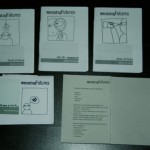
Proboscis have been invited to make a film that will be presented as part of a Leonardo/MIT mobile digital exhibition curated by Jeremy Hight. The film will provide an abstracted overview of Proboscis’ themes and projects over the past few years and will be made and illustrated by Alice. However, the process of making the film was begun by Mandy who drew up the storyboard which has now been converted into the Tangled Threads eBook.
Mandy’s starting point was a piece of text I wrote which aimed to invoke the imagery and metaphors often used by Proboscis to describe their projects. The text also provided points for jumping into more detailed overview of Proboscis’ work from the past few years. Mandy took this text and transformed it into an intricate and beautiful mix of words and illustrations.
Storyboard panel sketches for Tangled Threads
Mandy moved quickly to produce her initial sketches, discarding ideas and developing a single artistic strand. After creating the storyboard panels you can see above she worked on individual frames drawing them up in detail before digitally painted the images to produce a full-colour illustrated eBook.
At the back of the eBook are a number of illustrations for you to cut out and stick them into the allocated spaces throughout the pages. Instructions for doing this are provided on pages 1 and 2. Making Tangled Threads the very first pop-up eBook!
Whilst researching the zine scene, I’ve noticed there seems to be a distinct lack of literary and poetry zines being produced, which pains me as they are my primary loves. It seems odd, as the popularity of the zine owes a lot to the short, self-published books of poetry and prose by the beat generation, known commonly as “chapbooks”. These enabled anyone to distribute their work without the aid of a publisher, which would sometimes be impossible with the strict censorship and decency laws of the time. This D.I.Y spirit is the driving force of the zine community today, but the focus has shifted onto more visual outputs; inevitable with modern printing capabilities and the vast amount (and talent) of illustrators and graphic designers involved in the scene.
There was a lot of interesting points raised during a recent meeting with The Poetry Society, one being the difference between publishing online on a personal blog, and being part of a publication with a bigger picture. Whilst promoting the Pitch In & Publish series of events, I’m hoping writers in particular get involved, as bookleteer has a lot of potential for those who may not be blessed with a wealth of design skills or self-publishing know-how, and being featured in the collaborative zines produced should definitely build budding writers confidence.
bookleteer has collaborated with writer Tony White a number of times on workshops and publications, however, I only became aware of his publishing venture – Piece of Paper Press – this week despite the fact that it’s been running for 16 years! In this time, 25 publications have been released, the latest one being Atomanotes by Liliane Lijn which was launched just this week.
Each Piece of Paper Press publication is a run of 150 books and each book is made from a double-side-printed sheet of A4 paper, folded three times and cut and stapled to create a 16-page A7-size book. Once printed the books are given away to people who attend the publication launch, to participants and to supporters of Piece of Paper Press. Despite the technological developments that have occurred in the 16 years since Piece of Paper Press began the production process is the same as it was at the beginning and Tony believes that it’s simplicity and low cost are the reasons why he has continued putting out these books for such a long time.
In a fascinating post on The Literary Platform, Tony writes that he feels the flipside to these methods of production and distribution is that “producing something this ephemeral in such relatively small quantities seems to go against the grain.” I would argue that Piece of Paper Press’s methods of making and sharing are actually adding value to their books in ways that digital accessibility is often unable to do. Printing only 150 copies gives a rarity to the books that will only increase with time and touches on ideas in this post on 3 Ways to Share.
In the same post Tony describes the process of physically making the books as a simple, repetitive and social occasion.
“for the past 16 years once or twice a year I’ve sat down for a morning or an afternoon with a pile of printed A4 paper, a stapler and a Stanley knife. With me more often than not will have been an artist or a writer who will have spent a year or more producing a literary or graphic work that is suitable for a 16 page, A7 book. A few cups of tea and some conversation form the backdrop to a task that is a by definition repetitive, but which is also very social and above all is simple and functional.”
With only 25 publications in 16 years very few people will have had the chance to sit down with Tony and enjoy this time and these conversations and it seems to me that these social aspects of Piece of Paper Press publications have a value in terms of the relationship between author and publisher and book and reader that may not be as easy to achieve with digital books despite being able to reach a wider audience.
Visual description of how bookcrossing works from www.bookcrossing.com
Label. Share. Follow. That’s how bookcrossing.com describes the process of setting your book free to go out and explore the world while you follow it’s adventures, the places it goes and the people it meets from the comfort of your home. According to the Book Crossing website almost seven million books have been registered by over 850,000 active BookCrossers and are traveling around 130 countries as I write.
The way it works is that each book is tagged with a label recording its unique Book Crossing ID (BCID) and starting location. The books are then shared, either being passed onto a friend or stranger, mailed to a Book Crossing reader who’s advertised for that title, or released ‘into the wild’, for example, on a park bench, a café table or at the train station. They can also be taken to Official Book Crossing Zones where books are regularly caught and released.
When your labeled book is ‘caught’ the finder enters its BCID into bookcrossing.com to find out who released the book and where it’s previously been. The finder can then record a journal entry telling the next stage of the book’s story. In this way you can find out where your book is, who’s reading it now, and follow where it goes next. Leave your book at an airport and it could cross continents!
Of course, theory is all very well but practice is what counts so I set out to catch a bookcrossing book. I chose my quarry carefully, discounting books that had been released on the tube or park benches as I couldn’t believe they would last more than a few hours in these locations. Eventually I settled on hunting down a book at the Camel and Artichoke pub behind Waterloo station where 89 books were listed – suggesting that I had a good chance of finding one!
I entered the pub and casually browsed around as if I was looking for a friend. And there, at the top of the stairs was my target. Four book shelves all stuffed with books. They were even spilling onto the floor. There was a wide variety of authors, topics, even languages (Simone de Beauvoir in German anyone?) but I finally settled for revisiting my childhood with The Silver Chair by CS Lewis.
My caught book
Returning home and entering its BCID into bookcrossing.com I discover that Lydiasbooks left it in the Camel and Artichoke as she had a duplicate copy. It’s been there about a month and I am the first person to pick it up.
My plan was to complete my bookcrossing experience before writing this post by releasing my book back into the wild. However, I kind of feel like re-reading The Silver Chair now. Perhaps this is how bookcrossing works. Serendipitous and random sharing leads to serendipitous and random reading..
A couple of weeks ago I wrote a couple of posts about libraries, librarians and what services and characteristics they might provide in the future based on the talks and discussion at Be2camp Brum 2010.
To my mind, a library’s primary function is to lend books to people and this service of sharing books in a community is beautifully carried out by this library-in-a-phone-box in Westbury-sub-Mendip, Somerset.
The phone box was bought from BT for £1 in 2009 and then a tea party was held to decide what to do with it. The idea of a mini-library was instantly popular as the nearest public library is four miles away and the mobile library stopped visiting the year before.
There is no full-time librarian and the phone box is open 24 hours a day, seven days a week for members of the village to pop by and drop off books and borrow new ones. There are four wooden shelves of books and the children’s section is a red box on the floor.
I think it’s a great reminder that libraries don’t have to be huge to be valued and makes me wonder what an eBook library might look like and where it might be located. Perhaps a cardboard box in the corner of a café or an old cupboard at the end of the street is all that is needed..
Aside from my work at Proboscis I’m currently busy organising the Inspiring Digital Engagement Festival taking place in Sheffield on 15 September 2010. As part of this event we plan to use eBooks to gather feedback from participants about the day and their feelings and experiences of it. So I have been browsing the diffusion library to see how other people have approached using eBooks for this task and have come across a number of examples.
eBooks from Articulating Futures by Niharika Hariharan; eNotebooks from school workshops; StoryCubes at bTween
In the Articulating Futures workshop run by Niharika Hariharan eBooks were designed to take the students through the different workshop activities. The eBooks acted as personal journals and tools for them to bring their ideas together and were used to reflect over the proceedings of each day. Proboscis have made a number of eNotebooks to use as learning diaries for school workshops such as Experiencing Democracy and Sound Scavenging, as field notebooks to collect ideas in projects such as St Marks and as evaluation tools at conferences such as Enter. At bTween in Manchester 2008 Story Cubes were used to collect people’s answers to questions around new technologies. A similar premise could easily have asked for feedback from participants on the event itself.
A blank probe pack
Finally, a chat with my co-organiser this afternoon reminded me of the eBooks that Orlagh, Niharika and I made for the probe packs we put together as part of Being in Common. These were sent out to twenty people with very different lifestyles and understanding of space living all over the world. The packs were designed to collect participants thoughts, feelings and experiences of common space. Participants returned the packs to Proboscis once they had completed it. You can read more about the probe packs and the *amazing* things people did with them here. It is this kind of reflective eNotebook that I would like to create for the Inspiring Digital Engagement Festival. Of course, you’ll be the first to know how I get on..
Download Articulating Futures eBooks from diffusion.org.uk.
Read about StoryCubes at bTween here.
Find out more about eNotebooks here.
A few days ago we published a ScrapBook made at the Vintage Festival for a project Proboscis is participating in called Graffito – a collaborative iPhone/iPad app that lets people draw on a shared canvas. It was used in the Warehouse tent (which had a 1980s theme) as a collaborative VJ system displayed on a giant LED screen. A number of iPhones were lent out to people to draw with, as well as remote users playing from all over the world (the App is free to download from the AppStore).
For part of the 3 day festival, Jennifer Sheridan (Graffito’s project lead) sat in the control booth capturing snapshots of the screen and printing them off using a Polaroid PoGo printer (a very small portable printer that uses USB & Bluetooth to print ‘zero ink’ pictures from mobiles or digital cameras). She then stuck them into a blank eNoteBook I had designed especially for Graffito. Once back from the festival we disassembled the ‘ScrapBook’, scanned it in and republished it so anyone (whether at the festival, a remote participant or just someone interested) could have a hand made tangible souvenir of the project and the event. The process was very simple (though not helped by Apple’s blocking of Bluetooth connection to the PoGo printer on the iPhone) and points the way to similar uses for lots of other projects. In fact the whole process could easily be copied by anyone with an iPhone : simply download the Graffito app, start drawing and use the ‘snapshot’ feature to capture pictures of your favourite screens. Then download the blank version of the Graffito ScrapBook from diffusion.org.uk, print out and stick in the screen shots to make your own personal Graffito ScrapBook. You don’t need a PoGo printer (though they’re now very cheap to buy, around £20) – you could just print out the pictures on normal paper and glue them in.
As we develop Graffito further, part of our thinking will focus around how to personalise the creation of tangible souvenirs from the project even further. It could be possible, for instance, to request a series of screen shots to be taken from a particular time sequence and made into an eBook or StoryCube. This could be particularly fun for a group of people using it to draw collaboratively and could be combined with maps of where users are located in the world (there’s a short movie demonstrating this on the Graffito website).
I think this ScrapBook is a great example of just how simple it can be to design and make custom eNoteBooks or ScrapBooks for projects and events with bookleteer. Using simple and cheap tools like the PoGo printer, its possible to capture and print images using mobile phones (or cameras via USB) which can be stuck in and notes written around them. Whether its for festivals, art events, schools projects, field research or sports events, its possible to create beautiful and engaging ScrapBooks ‘in the field’ – as they are happening – that can be shared with anyone afterwards.
Get in touch if you’d like us to design a way of creating tangible souvenirs like this for your project or event.
Andy demonstrating Tales of Things at Be2Camp Brum 2010; via Meshed Media
Today’s post is another presentation I heard at Be2camp Brum 2010 last week. (It was truly an inspiring and thought-provoking day!) Tales of Things was presented by Andy Hudson-Smith from the Centre for Advanced Spatial Analysis, UCL. Tales of Things explores social memory and asks what happens if we can tag objects in our everyday environment and track these objects – even after we’ve passed them on to someone else.
Entering details of an object into the Tales of Things website allows you to generate a unique QR code for that item which can be printed out and attached to the object. When the QR code is ‘read’ by a camera the web page for that object is triggered. Because Be2Camp Brum was loosely focused around the theme of libraries Andy used tagging books as an example, suggesting that tagged books would be able to use Twitter to keep previous owners up to date with the book’s current location and status.
The Tales of Things website suggests that:
“The project will offer a new way for people to place more value on their own objects in an increasingly disposable economy. As more importance is placed on the objects that are already parts of people’s lives it is hoped that family or friends may find new uses for old objects and encourage people to think twice before throwing something away.”
Promoting the sharing and exchange of objects in this way is obviously interesting in the context of bookleteer and I did actually tag a couple of eBooks with QR codes generated by Tales of Things for Pitch Up & Publish 10: Augmented Reading a few weeks back. Perhaps it’s time for me to go back and revisit that and see where it might lead..
If you want to read more about the project see here, or if you just want to get on and tag your stuff then look here..
Even though the eBook Treasure Hunt took place in 2009 I hadn’t come across it until I was looking for projects for my talk at Be2camp Brum 2010 last week. I used this project to help me explain the idea that eBooks facilitate shared making. I thought it was really great and I wanted to share it with you here too.
The eBook Treasure Hunt was designed and implemented by Kevin Harris of Local Level with Manningham Library in Bradford. The library was undergoing refurbishment and the Treasure Hunt was part of a public event to engage people with the refurbishment project and open up a period of consultation.
Treasure Hunt participants followed clues that sent them to specific spots around the library that would be affected by the refurbishment. The first clue was printed in the eBook and asked “Where are the books about Bradford?” Answers to the questions were written into the eBook and supplementary questions were designed to solicit ideas for the new building. The supplementary question for the first clue read “How else might the new library be used to celebrate Bradford and Manningham?” When they found the place in the library that held the answer participants were handed a sticky label with the next clue on. This was stuck onto a new page in the eBook.
In this post on diffusion.org.uk Kevin writes that the eBook Treasure Hunt worked well and no-one had difficulty following the clues or the instructions about where to place the sticky labels. He goes onto say that, in part, the success was because the activity took place in an ongoing mix of engagement activities and processes. Library staff were on hand at the event to hand out clues, give hints and generally smooth the process. He also wrote this post on his own blog about how the eBooks and questions were designed. I think this is such a thoughtful well-considered approach to engagement and consultation I encourage you to read the rest of the post.
As far as shared making goes I think this is a great example of how different types of making can come together in an eBook. Kevin designed the eBook and entered the content into bookleteer, librarians at Manningham then printed out the A4 eBook sheets and made them up into the A6 eBooks. Finally, the treasure hunt participants took these eNotebooks and made them unique and personal with their answers and ideas. Three types of making, one eBook!
The Manningham Library Treasure Hunt eBook is available for download here.
Last week I began to draft a post about digital artist Dave McKean’s illustrations. I was planning to return to the half-written post when I got an email from Giles saying did I know that Dave McKean illustrated a piece of writing for COIL (the Journal of the Moving Image which Giles founded and edited) in the late 1990’s? Well, no, I didn’t. But now I do, this makes a perfect focus for writing about his work. All images below are from The Entrapment from COIL 7 | 1998. Thanks for the tip Giles!
Since 1994 Dave McKean’s been producing extensively layered images using computers and digital manipulation. In his collaborations with writers, illustrations and text appear to be intertwined so that the paper becomes part of the content and I was interested to find out how he achieves this effect. In an interview on Apple’s website he describes how his approach has changed with the increasing sophistication of digital technologies.
“The major things that have changed … are the tools and materials I’ve been able to use. When I started on ‘The Sandman,’ I was aiming toward a translucent collage, a layered look, an insubstantial feeling where you’ve just got an atmosphere. I tried to do that with things like double exposures and different printing techniques. To a degree, this approach is always pretty limited by the fact that the illustration has to be a physical object and, if I have to photograph it, limited by gravity.”
The illustrations for COIL were made in 1998 (COIL 7) for a supposedly ‘anonymous’ piece actually written by legendary indie producer Keith Griffiths (of Koninck fame) about a film he produced by Iain Sinclair & Chris Petit called the Falconer – itself about another ‘legendary’ 60s filmmaker called Peter Whitehead. Its a many-layered piece about becoming trapped in the layers of legend and hype spun around Whitehead and the narrator’s (“Darke”) attempt to unravel the story. Darke is a thinly veiled characterisation of the Falconer’s script writer (and 90s film critic) Chris Darke. The techniques of double exposure and layering that Dave McKean mentions in the interview with Apple are clearly visible in the collages of text and images he produced for this.
The process of creating these illustration begins with “endless drawings.” Out of these, one is chosen and painted onto a backboard of colour photographs and paper collages, a basic canvas already with a life to it, containing interesting textures, colours and shapes. Illustration comes next where McKean paints the characters onto the canvas. From here, the process moves onto the computer. “Sometimes I finish it [the painting] quite well and sometimes I leave it open and rough, scan it and make sense of it in the computer. The compositing is the fun bit, really, and dragging all these elements together all happens very quickly.” As McKean writes, it’s an explorative way of working, “I like the fact that I don’t really know what I’m aiming toward completely. I have an idea, but it’s also the shapes shifted and composited in the computer that allow me to find a nice blend.”
In fact, it seems that his process and approach has remained surprisingly constant as tools and materials have evolved. In this article, he suggests this goes back to his college days at Berkshire College of Art and Design, “Before drawing anything we had to have a clear idea of what we were trying to achieve. So to this day, I still write personal briefs for myself. I still need to be clear in my own mind what I’m doing.”
For me, what is so inspiring about this description of the process is that having a clear plan from the outset in no way constrains the experimental, organic nature of the final illustrations. As he writes, “Techniques may change and go in and out of fashion, but ideas are always worth exploring and re-interpreting.” I wonder if we could get him to design an eBook…