If you’re planning to print some eBooks or StoryCubes in time for Christmas, here are our last printing dates :
eBooks
UK orders : 6th December (3pm GMT)
International orders : 1st December (3pm GMT)
StoryCubes
All orders : 1st December (3pm GMT)
Some Christmas Ideas StoryCubes and eBooks can make great gifts – why not design a Christmas StoryCube to send instead of a card, or print a photo book of family pictures to share with relatives? At bookleteer’s PPOD prices, individual eBooks and StoryCubes can work out at similar prices to traditional designer Christmas cards. Some pre-bookleteer Christmas cubes by Proboscis, 2006
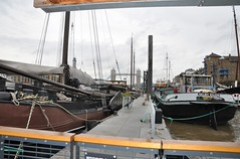
Last Friday we held our second Pitch In & Publish: City As Material event on the topic of River. We met at Hermitage Moorings in Wapping (where one of the participants is a founder member) and spent a short time introducing ourselves and our interests in the topic. Taking part were Anne Lydiat, Aleaxandra McGlynn, Aurelia McGlynn-Richon, Ben Eastop, Martin Fidler, Fred Garnett and myself. I had prepared a map with a possible route for us to take from our point of origin back to Proboscis’ studio and this served as a useful conversation point about the nature of the river as a channel for transportation, habitation, pleasure, boundary, margin and about the city’s push/pull relationship with it.
Whilst sitting in the Hermitage Pier House, then on Anne’s boat in the river the conversation flowed across these issues of liminality and tension – about how the city has slowly encroached on the river, fixing artificial banks where it previously had a wide flood plain, such that we are now concerned about that flood plain being at risk with rising sea levels. Ben, who also lives on the river, spoke of how his home is different every day, changing position with the tide and weather; he also talked of the enormous variation that the sky, light and weather has on the character of the water and its constantly changing surface.
From Hermitage we then walked west along the Thames Path via St Katherine Dock, the Tower of London, Customs House, Old Billingsgate to Queenhithe, where we turned north and cut through the City, St Pauls, St Barts and Smithfield to arrive at the studio.
We talked about how the city so often seems to turn its back on the river, to build buildings that look inward to the city, and how its is only recently, with the shift in the Port of London to Tilbury that Londoners have at last begun to reclaim access to the river from what were previously commercial wharves and stairs. As it was low tide at 12.30pm we were able to include some beachcombing/ mudlarking with our walk – finding the ubiquitous clay pipe stems and pottery shards from earlier centuries, as well as the ever present animal bones, tiles and chalk. we shared stories and bits of knowledge about these stairs, their uses, the hidden rivers flowing out into the Thames.
Arriving back at the studio we began collating the drawings, objects, ideas, writings and photographs that had been created along the way and started to sketch out the structure of the collaborative publication – Ebb and Flow – which is now available. There is also a City As Material group on Flickr, and a Twitter hashtags – #cityasmaterial – to continue the discussions.
The next City As Material event will be on Friday 12th November on the topic of “Skyline” with artist Simon Pope as our guest. Book a place here : cityasmaterial.eventbrite.com
bookleteer members will have noticed a few changes to the site in September and October as we’ve pushed through a series of updates, changes and fixes to the platform. Here’s a quick run down of the most important of these from a member’s perspective, since many more were ‘under the hood’.
First Time eBook & StoryCube Generation
We’ve streamlined the process of generating eBooks and StoryCubes by making the initial button on the Create pages into ‘Upload & Generate PDFs’.
eBook & StoryCube PDF Thumbnails
This week we’ve implemented a change to replace the generic PDF icon with actual thumbnails of each PDF’s first sheet. This is designed to make it easier to distinguish different publications when shown in lists (such as the Inspirations or My Publications pages) and to give a quick preview once your eBooks and StoryCubes have been generated.
My Publications Page
Inspirations Page
Adding Images, PDFs & My Gallery
We have completely changed the way images and PDFs are added to eBooks and StoryCubes – there are now three ways to add an image :
upload a file from your computer
enter a URL for an image already online (for instance on Flickr)
browse through your gallery and use an image already uploaded
Create eBook Upload image from computer
Create eBook Page Insert Image from URL
Create eBook Page Add image from gallery
Create StoryCube Upload image from computer
Create StoryCube Page Insert image from URL
Create StoryCube Page Insert image from gallery
PDFs can also be chosen by either uploading a new file from your computer or selecting from a previously uploaded file in your gallery.
Create eBook Page Upload PDF
Create eBook Insert PDF from gallery
Create StoryCube Upload PDF from computer
Create StoryCube Insert PDF from gallery
Members can use the My Gallery page to review (and delete if necessary) any image files or PDFs in their account. My Gallery Page
Facebook Integration
Lastly, for those of you who use facebook, we’ve integrated bookleteer’s login so that you can automatically login to bookleteer when you are also logged in to facebook.
September was a busy month here at Proboscis and on bookleteer: we sent seven books to be printed via the PPOD service as well as 10 different StoryCubes. The range of publications was very broad, from books about exhibitions and art projects to a book in Arabic about a major archaeological excavation in Sudan and a special notebook for a symposium on digital engagement and another full of QR codes. The StoryCubes included an 8 cube ‘cube of cubes’ set by artists Joyce Majiski and Alice Angus on their Topographies & Tales project, a promotional cube about bookleteer itself and a cube by artist Melissa Bliss to promote her installation, Bird Song, at the b-side media festival in the Isle of Portland.
The photo above shows the various StoryCube and printed eBooks :
bookleteer will be offline for a few hours today as we do some scheduled maintenance and introduce some new features (the new image and content PDF gallery plus some other small tweaks). We’ll post more info about the changes when the site’s back online later today.
*** Update 18.30 : its taking us longer than anticipated mainly due to the production team working across several different timezones (UK, Australia, California!), but we hope be back in service around midnight BST.
*** Update 22.35 : we’re back – we hope you enjoy the new gallery feature and ability to add images to eBooks and StoryCube from URLs, new uploads and images already uploaded. We’re also introducing Facebook integration as the first stage of making bookleteer work better with other platforms.
Ten years ago this month, in September 2000, Proboscis published the first series of Diffusion eBooks – Performance Notations – initiating the start of the journey that has brought us to bookleteer.com. It was the culmination of ideas and designs about the future of publishing that themselves began back in early 1999 and were informed by 5 years of publishing traditional books and my experiences working in an interaction design research group (CRD Research) at the Royal College of Art.
I’ve written a post over on diffusion.org.uk recapping on the past decade and looking forward to what we’re planning to start the next one, specifically a series of events called ‘Pitch In & Publish‘ which will be the vehicle for publishing new series of collaboratively-produced Diffusion eBooks & StoryCubes. Its a twist on our ‘Pitch Up & Publish‘ events which were designed to introduce people to using bookleteer itself, getting them familiar with using it for themselves and their own projects. Pitch In & Publish will be firmly focused on creating and publishing new collaborative publications around specific themes and topics.
Look out for more details in the coming days…
As mentioned in a post I wrote a couple of weeks ago, we’re hard at work building the ‘beta’ version of bookleteer to make it simpler to use, more robust and developing new features to make it even more useful. However, this does come at a cost and we’re low on funds to pay for the costs of programming and hosting the service.
Last Autumn we set up the Alpha Club as an experiment in asking friends and supporters to help us ‘crowdfund’ some of the costs associated with developing bookleteer. So far almost two thousand pounds has been donated to the project, but its a long way short of the £10,000+ in programming fees and costs we’re on course to spend in 2010 – do please make a donation if you enjoy using it and want to support us. As an added sweetener, we’ll send a special pack of the brand new, larger StoryCubes to anyone who donates £25 or more and joins the Alpha Club in September and October. Members also get discounts on any PPOD orders that they make for professionally printed eBooks & StoryCubes.
Please get in touch to join Alpha Club or make a secure donation via Paypal:
bookleteer now has several hundred members signed up and using it, over 210 followers on twitter and around 115 followers on facebook. We’d love to see more people join this growing community of bookleteers creating and sharing their books and StoryCubes – please feel free to sign up for an account and get bookleteering.
A few days ago we published a ScrapBook made at the Vintage Festival for a project Proboscis is participating in called Graffito – a collaborative iPhone/iPad app that lets people draw on a shared canvas. It was used in the Warehouse tent (which had a 1980s theme) as a collaborative VJ system displayed on a giant LED screen. A number of iPhones were lent out to people to draw with, as well as remote users playing from all over the world (the App is free to download from the AppStore).
For part of the 3 day festival, Jennifer Sheridan (Graffito’s project lead) sat in the control booth capturing snapshots of the screen and printing them off using a Polaroid PoGo printer (a very small portable printer that uses USB & Bluetooth to print ‘zero ink’ pictures from mobiles or digital cameras). She then stuck them into a blank eNoteBook I had designed especially for Graffito. Once back from the festival we disassembled the ‘ScrapBook’, scanned it in and republished it so anyone (whether at the festival, a remote participant or just someone interested) could have a hand made tangible souvenir of the project and the event. The process was very simple (though not helped by Apple’s blocking of Bluetooth connection to the PoGo printer on the iPhone) and points the way to similar uses for lots of other projects. In fact the whole process could easily be copied by anyone with an iPhone : simply download the Graffito app, start drawing and use the ‘snapshot’ feature to capture pictures of your favourite screens. Then download the blank version of the Graffito ScrapBook from diffusion.org.uk, print out and stick in the screen shots to make your own personal Graffito ScrapBook. You don’t need a PoGo printer (though they’re now very cheap to buy, around £20) – you could just print out the pictures on normal paper and glue them in.
As we develop Graffito further, part of our thinking will focus around how to personalise the creation of tangible souvenirs from the project even further. It could be possible, for instance, to request a series of screen shots to be taken from a particular time sequence and made into an eBook or StoryCube. This could be particularly fun for a group of people using it to draw collaboratively and could be combined with maps of where users are located in the world (there’s a short movie demonstrating this on the Graffito website).
I think this ScrapBook is a great example of just how simple it can be to design and make custom eNoteBooks or ScrapBooks for projects and events with bookleteer. Using simple and cheap tools like the PoGo printer, its possible to capture and print images using mobile phones (or cameras via USB) which can be stuck in and notes written around them. Whether its for festivals, art events, schools projects, field research or sports events, its possible to create beautiful and engaging ScrapBooks ‘in the field’ – as they are happening – that can be shared with anyone afterwards.
Get in touch if you’d like us to design a way of creating tangible souvenirs like this for your project or event.
Recently we’ve been tweaking things under the hood of bookleteer and planning the transition to a public beta version (hopefully later this year). I thought I’d give a brief outline of some of the improvements we’re planning to introduce soon and a look ahead to how we’ll shape bookleteer in the future.
Forthcoming Updates & Tweaks
In the next couple of weeks we’ll be deploying an update that will provide an image and file gallery to allow users to better manage their images and source PDF files. Images used frequently on different publications (such as logos or Creative Commons graphics) will only need be uploaded once. It will also allow users to link directly to images on their own websites or services such as Flickr (via a URL). We think this will streamline how images are used and make using bookleteer more intuitive and personal at the same time.
Users will have noticed some smaller changes recently : links on the dashboard to our Facebook page and activity there; a gallery of images tagged with “bookleteer” on Flickr and a feed of the latest free-to-download eBooks & StoryCubes to be posted on diffusion.org.uk. We’re hoping more users will use the facebook page to share their experiences and use the “bookleteer” tag to post photos of their own eBooks and StoryCubes.
Public Beta
This will be a major upgrade to bookleteer and enable some very exciting new ways for users to create eBooks & StoryCubes, both individually and collaboratively. We’re planning to introduce a premium paid-for account with some exclusive services :
– creating groups of other bookleteers and sharing collaborative editing privileges for eBooks & StoryCubes
– access to a bookleteer API to allow eBooks & StoryCubes to be generated from their own applications and stored in their user accounts
– a ‘scrapbook’ app for mobiles (iPhone/iPad/Android) allowing users to send bookleteer text and images from their mobile devices to generate eBooks & StoryCubes
Free users will continue to be able to create eBooks & StoryCubes of their own (though limited to a smaller number of ‘active’ publications and server space than premium users) and to order PPOD versions.
We’re also looking into other features and greater integration with social media platforms like Facebook & Flickr, as well as improving the interface design (whilst striving to keep it simple and elegant).
Alpha Club PPOD Discounts
Lastly we’ve added some new discounts on PPOD orders for Alpha Club Members – we’d like to sign up more members to help us fund the development of bookleteer as we are way off our fundraising target : if you like using bookleteer, please contribute if you can.
Here at Proboscis we are very excited by the quality of the new PPOD service we’re offering users of bookleteer, but we also recognise that there are still economic barriers to people wanting to break into publishing their own eBooks & StoryCubes. Despite our ground-breaking service offering low-run printing (from only 50 copies per title, much lower than the industry standard of 500 or 1,000 copies) this still requires bookleteers to pay up front for printed versions of their eBooks & StoryCubes. Our aim is to open up publishing with bookleteer by removing as many of the traditional barriers as possible.
With bookleteer you can currently create shareable eBooks and StoryCubes that you can send or allow people to download anywhere in the world at no cost; you can also have high quality professionally printed & bound versions made. Our pricing for this has been set to make it as affordable as possible, so that users can sell on their printed eBooks/StoryCubes and add their own profit margin. But, for many people, the cost of printing even just 50 copies might be more than they can afford or justify on the basis of anticipated (or hoped for) future sales.
In trying to resolve the puzzle of how to allow people to use bookleteer not just to create things which they pay for, but which also allows them to earn money from their creativity, we’re now researching a concept for a crowdfunded marketplace. What we’d like to implement in the future (possibly in the beta version later this year) would be a bookleteer marketplace where the users can submit their eBooks and StoryCubes (either individually or a series / collections). We imagine that the user will set the retail price of the publication, add an ISBN number (if they have one) and set a target number of sales to be achieved before the publication will be printed via our PPOD service.
The marketplace would be public for anyone to browse and, using some kind of crowdfunding platform, pledge to buy a copy or copies of the eBooks/StoryCubes. Payments from buyers would be held in escrow until the sales threshold is reached and the printing and shipping of the publication triggered. At that point we would transfer the creator’s share of the sales to them (minus our printing & shipping costs). If there aren’t enough pledges within a given time frame to trigger the printing, then the buyer’s money would be returned to them. This approach, also called threshold pledging, would reduce the risk to both creator and buyer.
We are just at the very beginning of developing this concept and its going to require more resources and expertise than are currently available to us to actually turn into a reality – however we would really like to know what other people think of this. We’d love to hear from anyone with experience in building crowdfunding systems or using crowdfunding platforms to see if this is possible and what the average ratios are of successful to unsuccessful targets being reached.
We’d like to think that this idea could make it possible for anyone to be able to create a publication and have it professionally printed and bound without having to find the money to do so up front. With bookleteer they would be able to make the Diffusion eBook PDFs available for people to make their own handmade versions, then choose to buy the PPOD version (thereby economically supporting the creator). In this way we could create a whole new generation of publishers, crossing economic as well as cultural divides, allowing more people to find different ways of sharing their ideas, stories, knowledge, artworks – whatever they value and wish to share.