This was created to commemorate the 20th anniversary of Cosmo China, a handpainted ceramic studio and shop in Bloomsbury, London. To celebrate, Cosmo held a special exhibition of 20 plates painted by their artists (and a few special guests) for the occasion, which are showcased in the eBook.
Each page is devoted to one of the plates, and has a brief biography and picture of the artist. The simple format really allows the wonderful designs to shine through, and serves as a great souvenir of the exhibition, or even if the reader wasn’t there, an advert for Cosmo’s talent and charm.
Using eBooks to accompany exhibitions and galleries would make a refreshing change; a portable and attractive guide that trumps individual cards that often get lost or ignored. Curators could also provide an eBook notebook, for people to customise with stickers next to each exhibit that they find interesting – a personalised account of the event.
I know that I last promised an update on my examination of the eNotebooks, but I’ve found it necessary to take a bit of a detour before doing this which means reevaluating the kind of frameworks that are required. In the meantime, I’ve been taking stock of some potentially relevant work.
Last April, I read an article by Gary Wolf in the New York Times Magazine about people who are “self-trackers” – that is, people who use new digital tools and services to produce data about themselves or their activities. The article stuck in my mind because it definitely fell into the category of “people who create information in unconventional ways” – a topic that I was (and still am) interested in. But I didn’t think much more of it at the time. Then on Monday morning, I came across this article on Slate by Michael Agger titled Data for a Better Planet where the Wolf articles came-up again. It gave me an opportunity to revisit the other article and the blog where Wolf and others write regularly.
What interests me in this type of research is how people who aren’t necessarily social scientists or other kinds of expert researchers use tools and methods inspired by these disciplines to produce information. What I found particularly frustrating about the Slate article was that it completely overlooked one of the fundamental points that Wolf was trying to make in the NY Times Magazine article. Agger’s interest in self-tracking seems to be limited to how it represents an opportunity for people to “improve society” by “sharing their data”. In other words, collecting this data about yourself and making it available to everyone and anyone is somehow necessarily going to lead to more information and a better state of affairs. But I don’t want to get into lofty critiques of certain versions of information society that assume that more information is necessarily better or about how this certainly leads to problematic issues of surveillance and bio-politics.
Rather, what I find particularly problematic is that Agger is basing his argument on a set of assumptions about how all of this data can be collected and fed into standardised information frameworks. Who decides what data is valuable and what isn’t? What is the benefit of my knowing how others self-tracked their work patterns if I don’t share the same values about what are good work patterns? After rereading the Wolf article, I realised that what had left an impression on me was that he highlighted the eccentricity of the way in which these self-trackers were gathering data. The point of collecting this data and turning into information about their day-to-day activities wasn’t to change the world but to devise situated tactics for a better understanding of their everyday lives. The value of self-tracking for these people wasn’t only the information that was produced but the opportunity to think differently about a particular aspect of their lives. Part of the conclusion that Wolf came to when examining his own self-tracking was that he was putting too much emphasis on a certain kind of metrics for measuring the quality of his work:
“I got nothing from my tracking system until I used it as a source of critical perspective, not on my performance but on my assumptions about what was important to track.”
For Wolf, self-tracking represented a great way to challenge existing standards rather than building new ones. This understanding of data gathering practices as critique is exactly the kind of thing that seems to be a part of the ongoing work at Proboscis with the eBooks. Of course, there are also some significant differences including the fact that the kind of work people are doing with eBooks that I’ve encountered to date is less focused on the ‘self’ and that the “capturing” people have described with the eBooks is quite different from the “tracking” that Wolf described.
Last Friday we held our third Pitch In & Publish: City As Material event; the topic -“Skyline”. Taking part was our special guest, Simon Pope, as well as Giles Lane, Martin Fidler, Katharine Willis, plus our new addition to the Proboscis team, Radhika Patel, and myself. Meeting at Leadenhall Market, we listened as Simon explained his interest in the topic, whilst introducing the photo essay he created for the Skyline notebook, before starting our journey through the heart of the city.
Gazing upwards, we strolled towards the Gherkin and then Tower 42, before breaking off from our path to explore some secluded passages and elevated walkways, spotting little wonders you would never notice during everyday travels. Walking right past office worker’s windows, we got some unusual glances as we peered inside and discussed the relationship between the buildings in the City and its dwellers, taking heed of the abundance of CCTV camera’s recording our steps. These, plus the unusual nature of some of the areas we visited, almost make you feel as if you are trespassing, even though we were on public land; a hidden garden we wandered upon seemed to be a haven of exclusivity, with little seating alcoves that resembled guard posts.
Back in the main streets, we made our way to the Monument, our aim to ascend it’s 311 steps and be rewarded with an elevated view of the city. Traveling up the narrow, winding staircase was a hefty task, but once at the top the panorama was breathtaking. The sense of detachment from the lived in, street level, as the strong wind whipped across the tiny viewing platform, was poignant and surreal. 160 feet high, looking down at rooftops and across to spires, we saw London as a bird might, the human element below seeming very far away.
Thoroughly deserving of lunch, we had a rest, ate and further explored Simon’s photo essay, starting to pick up on themes and possible idea’s for the eBook we would produce back at the studio. Once there, we discussed the day and compared photos, as well as a GPS account of the route we took, from Katharine’s phone, and some amazing drawings by Martin, from a previous trip to the Monument. The concept of looking up, and down, rather than purely across at a skyline, really interested us, and inspired the format of the eBook we are currently creating as a result of the event. Look out for it soon on Diffusion, and keep track of the discussion online with the #cityasmaterial hash tag on Twitter. You can also view all our photos from the event on the City As Material Flickr page.
The next Pitch In & Publish: City As Material event, “Underside”, will be on the 26th of November, and will includeAlexanda Deschamps-Sonsino as our special guest. Book a place here.
If you’re planning to print some eBooks or StoryCubes in time for Christmas, here are our last printing dates :
eBooks
UK orders : 6th December (3pm GMT)
International orders : 1st December (3pm GMT)
StoryCubes
All orders : 1st December (3pm GMT)
Some Christmas Ideas StoryCubes and eBooks can make great gifts – why not design a Christmas StoryCube to send instead of a card, or print a photo book of family pictures to share with relatives? At bookleteer’s PPOD prices, individual eBooks and StoryCubes can work out at similar prices to traditional designer Christmas cards. Some pre-bookleteer Christmas cubes by Proboscis, 2006
“Another Way” by Ryan Todd (courtesy of the Zines page on Facebook), is a handstitched illustrated zine, each page with a comical visual pun that is subtly different from the expected norm. It’s super minimalist, and doesn’t seem to have any cover or accompanying text (aside from the back cover credits), which makes these charming, witty illustrations all the more stark and poignant.
The use of purely primary colours lends a really nice uniformity and iconic tone to this zine; it’s quite visually arresting. I’m looking forward to seeing what Ryan creates next. “Another Way” is available here.
This archive review comes courtesy of my fellow Future Jobs Fund employee here at Proboscis, Mandy Tang. The Storycube and accompanying eBook were actually the very first publications she created here – the ambitious concept speaks volumes about her work.
Picking a path, the player follows the line around the cube, until they reach one of six destinations, each with a different icon representing a personality type. The player then checks the eBook to read the corresponding description.
“What Type Are You?” really takes advantage of the cube form – the shape is integral to the game (as Mandy says: “When holding a cube you find yourself tempted to see whats on the other faces”). It’s also the first game in the archive – hopefully it will inspire fellow game-makers to create more. Download it here, and play it for yourself.
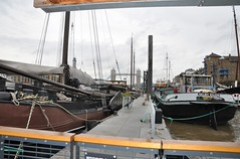
Last Friday we held our second Pitch In & Publish: City As Material event on the topic of River. We met at Hermitage Moorings in Wapping (where one of the participants is a founder member) and spent a short time introducing ourselves and our interests in the topic. Taking part were Anne Lydiat, Aleaxandra McGlynn, Aurelia McGlynn-Richon, Ben Eastop, Martin Fidler, Fred Garnett and myself. I had prepared a map with a possible route for us to take from our point of origin back to Proboscis’ studio and this served as a useful conversation point about the nature of the river as a channel for transportation, habitation, pleasure, boundary, margin and about the city’s push/pull relationship with it.
Whilst sitting in the Hermitage Pier House, then on Anne’s boat in the river the conversation flowed across these issues of liminality and tension – about how the city has slowly encroached on the river, fixing artificial banks where it previously had a wide flood plain, such that we are now concerned about that flood plain being at risk with rising sea levels. Ben, who also lives on the river, spoke of how his home is different every day, changing position with the tide and weather; he also talked of the enormous variation that the sky, light and weather has on the character of the water and its constantly changing surface.
From Hermitage we then walked west along the Thames Path via St Katherine Dock, the Tower of London, Customs House, Old Billingsgate to Queenhithe, where we turned north and cut through the City, St Pauls, St Barts and Smithfield to arrive at the studio.
We talked about how the city so often seems to turn its back on the river, to build buildings that look inward to the city, and how its is only recently, with the shift in the Port of London to Tilbury that Londoners have at last begun to reclaim access to the river from what were previously commercial wharves and stairs. As it was low tide at 12.30pm we were able to include some beachcombing/ mudlarking with our walk – finding the ubiquitous clay pipe stems and pottery shards from earlier centuries, as well as the ever present animal bones, tiles and chalk. we shared stories and bits of knowledge about these stairs, their uses, the hidden rivers flowing out into the Thames.
Arriving back at the studio we began collating the drawings, objects, ideas, writings and photographs that had been created along the way and started to sketch out the structure of the collaborative publication – Ebb and Flow – which is now available. There is also a City As Material group on Flickr, and a Twitter hashtags – #cityasmaterial – to continue the discussions.
The next City As Material event will be on Friday 12th November on the topic of “Skyline” with artist Simon Pope as our guest. Book a place here : cityasmaterial.eventbrite.com
These extraordinary creations are individually handmade by Stephanie Anderson, cut from paper and card. Each zine is a different burger with varying paper ingredients, and is limited to 20 copies. I suppose these are as far away from the typical imaginings of what a zine is, but innovation and creativity do tend to rock the boat.
These zines are tiny – no larger than a 10¢ piece. Apparently these are the smaller versions of Stephanie’s original Hamburger zine.
It would be great to create similar things by publishing an eBook with various ingredients that just need to be cut out and coloured in, then assembled. A cookbook for paper food – each page a different dish!
This illustrated scheduler was created by Alice Angus, whilst experimenting with eBook notebooks. Each month (a page) is adorned with one of her works, and writing spaces for tasks and notes. The simple design framework, coupled with her lovely ephemeral illustrations, combine to be one of the most visually pleasing (and functional) eBooks in the Diffusion Archive, even more so with the A3 version.
I rarely take notes, or form plans on paper, but even I’d be tempted to break this habit if it was on this canvas. I’d imagine it would initially be hard to write over the illustrations – I wouldn’t want to spoil them!
Perhaps having a beautiful notebook makes you more organised. Try it yourself – you can download it here.
bookleteer members will have noticed a few changes to the site in September and October as we’ve pushed through a series of updates, changes and fixes to the platform. Here’s a quick run down of the most important of these from a member’s perspective, since many more were ‘under the hood’.
First Time eBook & StoryCube Generation
We’ve streamlined the process of generating eBooks and StoryCubes by making the initial button on the Create pages into ‘Upload & Generate PDFs’.
eBook & StoryCube PDF Thumbnails
This week we’ve implemented a change to replace the generic PDF icon with actual thumbnails of each PDF’s first sheet. This is designed to make it easier to distinguish different publications when shown in lists (such as the Inspirations or My Publications pages) and to give a quick preview once your eBooks and StoryCubes have been generated.
My Publications Page
Inspirations Page
Adding Images, PDFs & My Gallery
We have completely changed the way images and PDFs are added to eBooks and StoryCubes – there are now three ways to add an image :
upload a file from your computer
enter a URL for an image already online (for instance on Flickr)
browse through your gallery and use an image already uploaded
Create eBook Upload image from computer
Create eBook Page Insert Image from URL
Create eBook Page Add image from gallery
Create StoryCube Upload image from computer
Create StoryCube Page Insert image from URL
Create StoryCube Page Insert image from gallery
PDFs can also be chosen by either uploading a new file from your computer or selecting from a previously uploaded file in your gallery.
Create eBook Page Upload PDF
Create eBook Insert PDF from gallery
Create StoryCube Upload PDF from computer
Create StoryCube Insert PDF from gallery
Members can use the My Gallery page to review (and delete if necessary) any image files or PDFs in their account. My Gallery Page
Facebook Integration
Lastly, for those of you who use facebook, we’ve integrated bookleteer’s login so that you can automatically login to bookleteer when you are also logged in to facebook.