Categories
inspiration making sharing

Piece of Paper Press

bookleteer has collaborated with writer Tony White a number of times on workshops and publications, however, I only became aware of his publishing venture – Piece of Paper Press – this week despite the fact that it’s been running for 16 years! In this time, 25 publications have been released, the latest one being Atomanotes by Liliane Lijn which was launched just this week.

Each Piece of Paper Press publication is a run of 150 books and each book is made from a double-side-printed sheet of A4 paper, folded three times and cut and stapled to create a 16-page A7-size book. Once printed the books are given away to people who attend the publication launch, to participants and to supporters of Piece of Paper Press. Despite the technological developments that have occurred in the 16 years since Piece of Paper Press began the production process is the same as it was at the beginning and Tony believes that it’s simplicity and low cost are the reasons why he has continued putting out these books for such a long time.

In a fascinating post on The Literary Platform, Tony writes that he feels the flipside to these methods of production and distribution is that “producing something this ephemeral in such relatively small quantities seems to go against the grain.” I would argue that Piece of Paper Press’s methods of making and sharing are actually adding value to their books in ways that digital accessibility is often unable to do. Printing only 150 copies gives a rarity to the books that will only increase with time and touches on ideas in this post on 3 Ways to Share.

In the same post Tony describes the process of physically making the books as a simple, repetitive and social occasion.

“for the past 16 years once or twice a year I’ve sat down for a morning or an afternoon with a pile of printed A4 paper, a stapler and a Stanley knife. With me more often than not will have been an artist or a writer who will have spent a year or more producing a literary or graphic work that is suitable for a 16 page, A7 book. A few cups of tea and some conversation form the backdrop to a task that is a by definition repetitive, but which is also very social and above all is simple and functional.”

With only 25 publications in 16 years very few people will have had the chance to sit down with Tony and enjoy this time and these conversations and it seems to me that these social aspects of Piece of Paper Press publications have a value in terms of the relationship between author and publisher and book and reader that may not be as easy to achieve with digital books despite being able to reach a wider audience.

Categories
publishing on demand

eBook Observer – some early thoughts

A recurring concern that has come up in the three interviews to date is the question of feedback. In all three cases I’ve presented to date, respondents told me that it was difficult to collect feedback on how the eBooks were used once they were out of their hands and into the hands of the people for whom the eBooks were designed. So lets get into this idea of feedback in a bit more detail.

I’m going to propose a first set of categories to distinguish how the eBooks are designed and used: eBooks are designed in some cases to capture knowledge and in other cases to publish information.

Publishing information with eBooks seems to involve organising bits of information – texts such as interview transcripts and project reports as well as images including pictures and logos – using one of the eBook templates. This newly designed eBook is subsequently made available to people who might be interested in the information it contains. A good example is how Gillian’s Greenhill projects involve using the eBooks as part of an “end point” to summarise her research.

The term “capturing” is used repeatedly by Proboscis and by some of the people who use the eBooks. It seems to be most often used to describe instances in which an eBook is used to codify some kind of event, experience or other tacit form of knowledge. I will therefore use “capture” to describe the cases where the eBook is designed and used as part of a process of generating information about something. A good example is when Ruth Sapsed describes how CCI uses the eBooks as part of workshops with teachers and other groups of people to see what they think about their own creative process. (Please note that some of the details of this work are not specifically detailed in the blog post presented.)

Now someone might argue that publishing is the same thing as capturing. After-all, isn’t Michelle Kasprzak codifying a captured event when she publishes her interview with a curator as an eBook? The distinction I want to make with these two categories is that capturing involves creating information whereas publishing involves recreating information.  Michelle’s interview had already been codified: for example, she may have already recorded the interview with some kind of recording device before she then transcribed the interview into a written document. By the time that she produced the eBook, the information contained within it had already been produced in at least one other iteration.

Publishing in the eBook format was a way to supplement the information it contained. In most cases, it was used to make that information more distinctive or special. It could also make that information more easily accessible as a printed document. Currently, the Bookleteer website does not seem to make a clear distinction between these two categories.

Coming back to my initial discussion of feedback using the distinction between publishing and capturing, it seems that feedback is lacking in the cases of publishing: the publishers are wondering what happens after they’ve been downloaded or printed. The capturing process is, in most cases, a process of getting feedback from respondents.

Categories
case study

Case Study – Gillian Cowell

This week’s eBook case study involves the work of researcher and community education worker Gillian Cowell. Gillian first encountered the eBooks online while doing research for her masters degree. She was interested in finding online tools help her to “capture data in a more interesting way for local people.” She was also hoping to turn the results of her research into something more unique than a regular research report. Although she had initially been attracted to the StoryCubes on the Proboscis website, she eventually received a version of the eBook after ordering a few things from Proboscis.

Sample project: Greenhill Digital Storytelling Guide

Categories
news

Crowdfunding bookleteer

As mentioned in a post I wrote a couple of weeks ago, we’re hard at work building the ‘beta’ version of bookleteer to make it simpler to use, more robust and developing new features to make it even more useful. However, this does come at a cost and we’re low on funds to pay for the costs of programming and hosting the service.

Last Autumn we set up the Alpha Club as an experiment in asking friends and supporters to help us ‘crowdfund’ some of the costs associated with developing bookleteer. So far almost two thousand pounds has been donated to the project, but its a long way short of the £10,000+ in programming fees and costs we’re on course to spend in 2010 – do please make a donation if you enjoy using it and want to support us. As an added sweetener, we’ll send a special pack of the brand new, larger StoryCubes to anyone who donates £25 or more and joins the Alpha Club in September and October. Members also get discounts on any PPOD orders that they make for professionally printed eBooks & StoryCubes.

Please get in touch to join Alpha Club or make a secure donation via Paypal:


New Medium Size StoryCubes

bookleteer now has several hundred members signed up and using it, over 210 followers on twitter and around 115 followers on facebook. We’d love to see more people join this growing community of bookleteers creating and sharing their books and StoryCubes – please feel free to sign up for an account and get bookleteering.

Categories
inspiration sharing

Every Book tells a Story


Visual description of how bookcrossing works from www.bookcrossing.com

Label. Share. Follow. That’s how bookcrossing.com describes the process of setting your book free to go out and explore the world while you follow it’s adventures, the places it goes and the people it meets from the comfort of your home. According to the Book Crossing website almost seven million books have been registered by over 850,000 active BookCrossers and are traveling around 130 countries as I write.

The way it works is that each book is tagged with a label recording its unique Book Crossing ID (BCID) and starting location. The books are then shared, either being passed onto a friend or stranger, mailed to a Book Crossing reader who’s advertised for that title, or released ‘into the wild’, for example, on a park bench, a café table or at the train station. They can also be taken to Official Book Crossing Zones where books are regularly caught and released.

When your labeled book is ‘caught’ the finder enters its BCID into bookcrossing.com to find out who released the book and where it’s previously been. The finder can then record a journal entry telling the next stage of the book’s story. In this way you can find out where your book is, who’s reading it now, and follow where it goes next. Leave your book at an airport and it could cross continents!

Of course, theory is all very well but practice is what counts so I set out to catch a bookcrossing book. I chose my quarry carefully, discounting books that had been released on the tube or park benches as I couldn’t believe they would last more than a few hours in these locations. Eventually I settled on hunting down a book at the Camel and Artichoke pub behind Waterloo station where 89 books were listed – suggesting that I had a good chance of finding one!

I entered the pub and casually browsed around as if I was looking for a friend. And there, at the top of the stairs was my target. Four book shelves all stuffed with books. They were even spilling onto the floor. There was a wide variety of authors, topics, even languages (Simone de Beauvoir in German anyone?) but I finally settled for revisiting my childhood with The Silver Chair by CS Lewis.


My caught book

Returning home and entering its BCID into bookcrossing.com I discover that Lydiasbooks left it in the Camel and Artichoke as she had a duplicate copy. It’s been there about a month and I am the first person to pick it up.

My plan was to complete my bookcrossing experience before writing this post by releasing my book back into the wild. However, I kind of feel like re-reading The Silver Chair now. Perhaps this is how bookcrossing works. Serendipitous and random sharing leads to serendipitous and random reading..

Categories
making

single sheet zine

I’ve been focusing on zines with unconventional formats recently, so I thought I would go the reverse way, and share a simple, traditional method of making a mini-zine from a single sheet of paper, with no glue or binding methods needed, just like Bookleteer. I’ve used A4 in this example, which makes a tiny 8 page booklet, perfect for short comics; each page is around the same size as a traditional comic book panel. You can make a 16 page book if you use both sides, but the reader needs to unfold and reverse the paper to read it all.

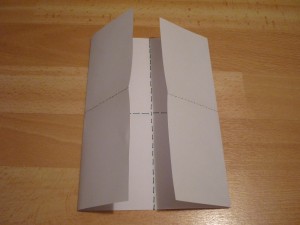
Start by folding the sheet of paper in half lengthways, then unfold and fold in half the short way, so the creases are along the dotted lines as shown above.

Then fold the edges in towards the center crease, and unfold. There will now be eight panels on the sheet, each one a page.

The bottom left panel will be your back cover, the next along your front cover. The layout of pages one through six are outlined above. Create your work on this template, then photocopy, or scan and print copies, and fold each sheet in the exact same way as the template.

To assemble, cut a slit lengthways along the middle, spanning two panels, as shown. You can use a scalpel, or simply fold the paper in half and cut the length of of one panel with scissors.

Fold the sheet lengthways so the bottom panels are in front, and bring the edges in so it takes the shape of a book.

Ta-dah! Now share.


Categories
inspiration sharing

Library in a Box

A couple of weeks ago I wrote a couple of posts about libraries, librarians and what services and characteristics they might provide in the future based on the talks and discussion at Be2camp Brum 2010.

To my mind,  a  library’s primary function is to lend books to people and this service of sharing books in a community is beautifully carried out by this library-in-a-phone-box in Westbury-sub-Mendip, Somerset.

The phone box was bought from BT for £1 in 2009 and then a tea party was held to decide what to do with it. The idea of a mini-library was instantly popular as the nearest public library is four miles away and the mobile library stopped visiting the year before.

There is no full-time librarian and the phone box is open 24 hours a day, seven days a week for members of the village to pop by and drop off books and borrow new ones. There are four wooden shelves of books and the children’s section is a red box on the floor.

I think it’s a great reminder that libraries don’t have to be huge to be valued and makes me wonder what an eBook library might look like and where it might be located. Perhaps a cardboard box in the corner of a café or an old cupboard at the end of the street is all that is needed..

Categories
events

The shapes of comics to come

The cube comics I looked at in my last post used non traditional page formats, and had an emphasis on physical interaction. Web comics can allow the reader to digitally interact with the story – clicking back and forth between pages, displaying animation and emitting sounds. Those that make use of these features are often dubbed “Hypercomics”, and can even have multilinear yet interrelated storylines. The current exhibition at the Pumphouse Gallery in Battersea Park, London, “Hypercomics: The Shapes Of Comics To Come”, places this digital concept in a physical art gallery, set across different levels, where visitors can actually walk through the story and branch off into multiple storylines.

Dave McKeans piece, “The Rut” uses a wide variety of media to describe a violent assault seen from three perspectives, the story becoming more ambiguous as you are led through the gallery.

This section, particularly the cornices that almost resemble StoryCubes, caught my eye, as it’s yet another example of a three-dimensional comic, this time even moving beyond paper as a medium. The “Shapes” portion of the exhibition title suddenly seems very relevant. I wonder how many more comics will make the transition from printed media to sculpture or gallery installation, and whether it would still be accurate to describe them as comics?

Categories
case study

Case Study – Michelle Kasprzak

Last week, I posted the first case study as part of my research on how Proboscis’ design for eBooks is being used. For me, CCI was a great example of how the eBooks are appropriated and used as part of a cultural organisation’s activities. Although Trail of Imagination and Curiosity was only one example of the kind of projects CCI is engaged in, these kinds of  workshops represented a key aspect of the work that CCI did and it seemed that the eBooks were becoming a key tool in the CCI toolbox for collecting and disseminating information.

The next case I want to present is considerably different in that the eBooks were not designed and used by members of an organisation, but by an independent curator and author: Michelle Kasprzak.

Michelle is currently working out of Amsterdam as the Project Director at McLuhan in Europe 2011. You can read more about her in here personal blog Michelle Kasprzak Art+Life+Technology.

I spoke to her from London via Skype on the 29 July 2010. Two specific examples of how she used the eBooks as part of her work came up in our exchange:

Sample project: Curating.info Conversations


Categories
inspiration making

eBooks for Evaluation and Reflection

Aside from my work at Proboscis I’m currently busy organising the Inspiring Digital Engagement Festival taking place in Sheffield on 15 September 2010. As part of this event we plan to use eBooks to gather feedback from participants about the day and their feelings and experiences of it. So I have been browsing the diffusion library to see how other people have approached using eBooks for this task and have come across a number of examples.


eBooks from Articulating Futures by Niharika Hariharan; eNotebooks from school workshops; StoryCubes at bTween

In the Articulating Futures workshop run by Niharika Hariharan eBooks were designed to take the students through the different workshop activities. The eBooks acted as personal journals and tools for them to bring their ideas together and were used  to reflect over the proceedings of each day. Proboscis have made a number of eNotebooks to use as learning diaries for school workshops such as Experiencing Democracy and Sound Scavenging, as field notebooks to collect ideas in projects such as St Marks and as evaluation tools at conferences such as Enter. At bTween in Manchester 2008 Story Cubes were used to collect people’s answers to questions around new technologies. A similar premise could easily have asked for feedback from participants on the event itself.


A blank probe pack

Finally, a chat with my co-organiser this afternoon reminded me of the eBooks that Orlagh, Niharika and I made for the probe packs we put together as part of Being in Common. These were sent out to twenty people with very different lifestyles and understanding of space living all over the world. The packs were designed to collect participants thoughts, feelings and experiences of common space. Participants returned the packs to Proboscis once they had completed it. You can read more about the probe packs and the *amazing* things people did with them here. It is this kind of reflective eNotebook that I would like to create for the Inspiring Digital Engagement Festival. Of course, you’ll be the first to know how I get on..

Download Articulating Futures eBooks from diffusion.org.uk.
Read about StoryCubes at bTween here.
Find out more about eNotebooks here.